
Nuremberg Chronicle Leaf | Liber Chronicarum


1493
Recto: Town view of Hiericho (Jericho) and image of a figure ascending in a horse-drawn conveyance.
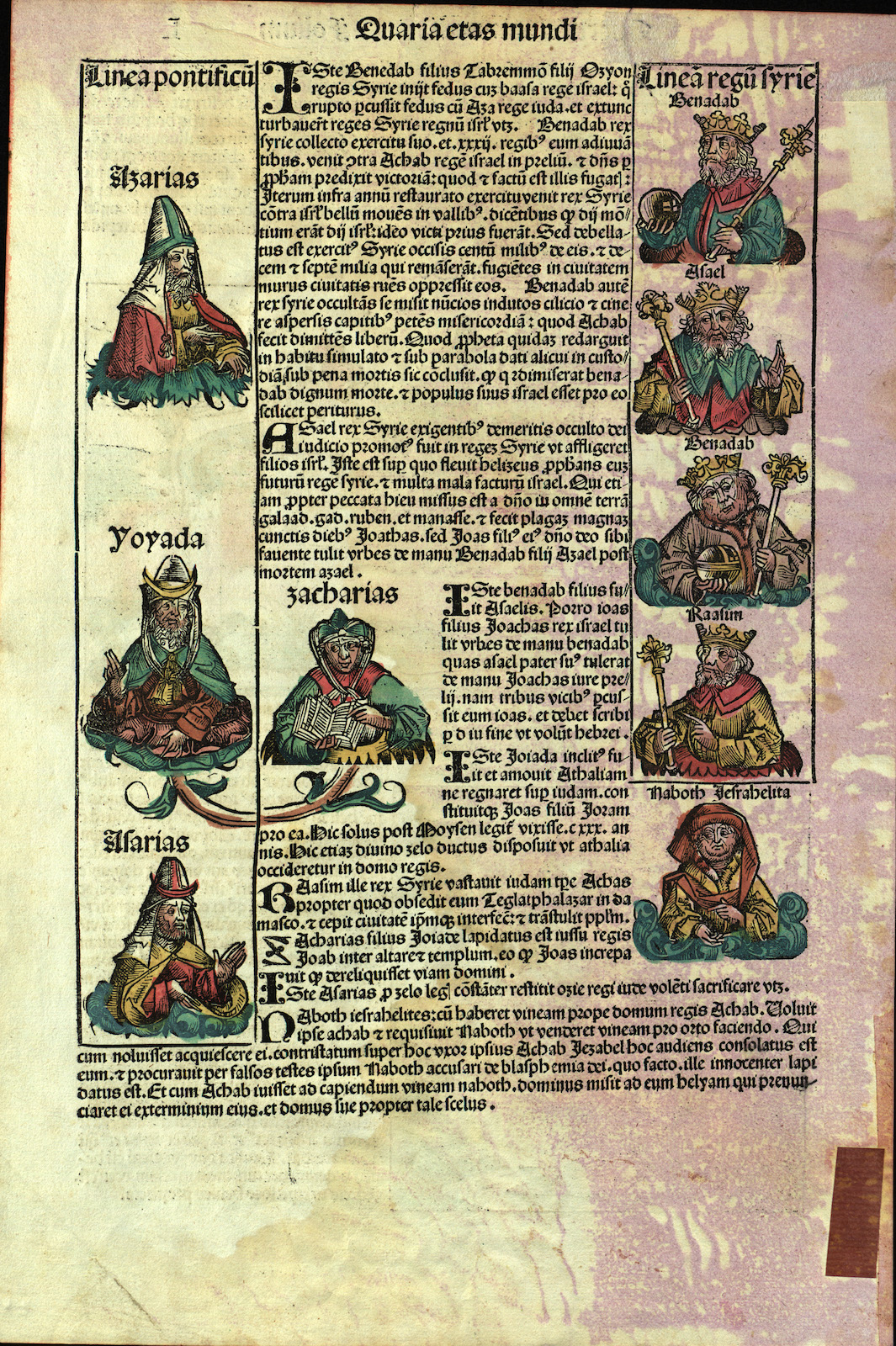
Verso: Linea Pontificu with three images; Linea Regu Syrie with 5 images and an image of Zacharias
Language: Latin
Illuminated in color
Portland State University Library Special Collections
Gift of Dr. Joe H. Rosenthal to the Harold Schnitzer Family Program in Judaic Studies.
Aya Attal, Medieval Portland Capstone Student, Spring 2022
Folio L from the Nuremberg Chronicle is placed within the “Fourth Age of the World”, titled in the Latin text as “Quarta etas mundi,” which is the time of David until the Babylonian captivity. The recto side of this folio portrays the cityscape of Jericho in full color. The text later goes on to describe Elisha’s dwelling in Jericho. Further down the page, Elijah is shown departing Earth on a chariot, and his apprentice Elisha gripping onto Elijah’s cloak in what seems to be an effort to keep him on Earth.
The verso side of this folio depicts the lineage of Syrian kings, as well as a priestly lineage continued from the previous folio (XLVIII recto). The priestly lineage from top to bottom depicts Azariah, son of Aimaaz, Jehoiada, Zechariah branching out from his father Jehoiada, and Azariah. The lineage of Syrian kings depicts Ben-hadad I, Hazael, Ben-hadad II, and Rezin. A portrait of Naboth is separate from both the kings and the priests, but his story ties into Ahab (not depicted), an Israeli king betrayed by Ben-hadad I of Syria.
The city of Jericho receives a lot of care in both the artwork and the text, being described as a once important holy land home to the prophet Elijah. Around the time this page was written in the 15th century, Nuremberg was experiencing an intense wave of the then quite new concept of humanism, which focuses on the importance of human accomplishments rather than of the divine.[1] This folio focuses on how Jericho housed splendid people and goods rather than focusing on godliness. It renders the ruins of an ancient people, rather than choosing to emphasize Jericho’s importance as a religious site.
At the same time as this book's printing in the late fifteenth century, the relationship between the Jewish population and the Protestant population of Nuremberg grew increasingly tense, culminating in an expulsion of Jewish people from Nuremberg approved by Maximillian I.[2] Originally, Jewish populations were welcomed into the city of Nuremberg and partially shielded in comparison to cities that were less trade-oriented.[3] However, following the Reformation in 1517, an increased sense of competition between Catholic and Jewish populations contributed to rising tensions and antisemitism, perhaps explaining the portrayal and emphasis on the kings of Syria and their acts as kings rather than the kings of Israel in this folio.[4] Interestingly, the kings of Syria are described in more detail than any of the priests or the kings of Israel, and there are no portraits on this folio of any of the kings of Israel, despite being extensively mentioned in the text. One king of Israel in particular, Ahab, is only mentioned in this folio as either engaging in war with a Syrian king or taking assets from a citizen, as showcased in the exclusion of a portrait of Ahab, and the inclusion of a portrait of Naboth, a citizen of Israel, executed by Ahab’s wife Jezebel, for refusing to sell his family’s vineyard to the king. Hazael, a king of Syria described as being wept over by Elisha for the atrocities he commits, still has a rather kingly portrait, and is described in the text as “the Lord’s punishment for Israel” due to unspecified actions of Joash, a king of Judah. [5]
Stepping back into the context of the bible, the author of this page most likely used the religious context to fulfill what he saw as a societal duty to portray the Israelites and Jewish people as little as possible, or in a negative light, due to the rising tensions of society at the time.
Notes
[1] Amy Nelson Burnett, "Revisiting Humanism and the Urban Reformation." Lutheran Quarterly 35, no. 4 (2021): 373-400.
[2] Nuremberg. https://www.jewishvirtuallibrary.org/nuremberg. Accessed 22 Apr. 2022.
[3] John D. Martin, “Dramatized Disputations: Late Medieval German Dramatizations of Jewish-Christian Religious Disputations, Church Policy, and Local Social Climates.” Medieval Encounters 8 (2002): 209–27.
[4] Sascha O. Becker, and Luigi Pascali, “Religion, Division of Labor, and Conflict: Anti-Semitism in Germany over 600 Years.” The American Economic Review 109, no. 5 (2019): 1764–1804.
[5] “Nuremberg Chronicle.” n.d. Accessed April 22, 2022. https://digicoll.library.wisc.edu/cgi/t/text/text-idx?c=nur;cc=nur;view=text;idno=nur.001.0004;rgn=div2;node=nur.001.0004%3A6.10.
Bibliography
Becker, Sascha O., and Luigi Pascali. “Religion, Division of Labor, and Conflict: Anti-Semitism in Germany over 600 Years.” The American Economic Review 109, no. 5 (2019): 1764–1804. doi:10.1257/aer.20170279.
Brown, Andrew. 2016. “Civic Religion in Late Medieval Europe.” Journal of Medieval History 42 (3): 338–56. https://doi.org/10.1080/03044181.2016.1162729.
Burnett, Amy Nelson. "Revisiting Humanism and the Urban Reformation." Lutheran Quarterly 35, no. 4 (2021): 373-400. doi:10.1353/lut.2021.0093.
Martin, John D. “Dramatized Disputations: Late Medieval German Dramatizations of Jewish-Christian Religious Disputations, Church Policy, and Local Social Climates.” Medieval Encounters 8 (2002): 209–27. https://doi.org/10.1163/15700670260497051.
Nuremberg. https://www.jewishvirtuallibrary.org/nuremberg. Accessed 22 Apr. 2022.
“Nuremberg, c. 1493 - Archives & Special Collections Library - Vassar College.” n.d. Accessed April 22, 2022. https://www.vassar.edu/specialcollections/exhibit-highlights/2011-2015/nuremberg-chronicle/essayexhibit.html.