
Nuremberg Chronicle Leaf | Liber Chronicarum


1493
folio XXXXVI (XLVI) (46)
Recto: “Anglie Provincia”
Verso: Linea Christi, Lineage of King David and King Solomon, images of 6 sons of David including Absalom.
folio XLVII (47)
Recto: continuation of the Lineage of King David and King Solomon
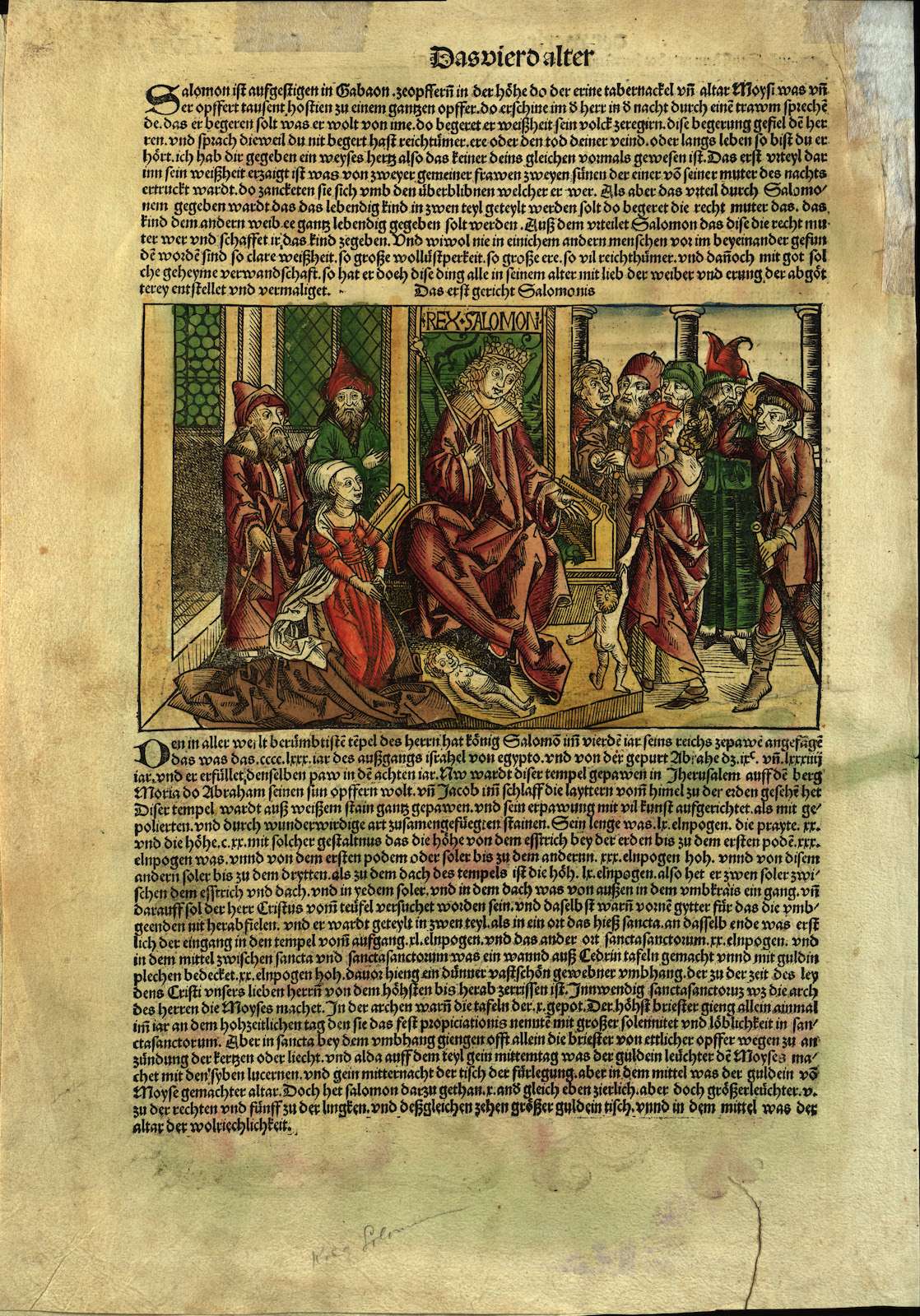
Verso: Judgement of King Solomon
1493
Language: German
Illuminated in color
Portland State University Library Special Collections
Gift of Dr. Joe H. Rosenthal to the Harold Schnitzer Family Program in Judaic Studies.
Lauren A Petrie, Medieval Portland Capstone Student, Spring 2023
Folio XXXXVI (XLVI) recto: Anglie Provincia
Folio XXXXVI (XLVI) (46) is from the German version of the Nuremberg Chronicle, printed in 1493, and set in the Third Age of the World. This section of the Chronicle tells the history of England and is accompanied by an elaborate illustration, though it is not known if this image is produced from observation or compiled from book models.[1][2]
The woodblock image on the lower half of the page depicts the fortified medieval town of London, bordered by the Thames that cuts through the cliff side and valley regions. The coastal landscape of England was noted for its tall cliffs by early mariners, and this is reflected on the woodblock itself, which possibly depicts the White Cliffs of Dover. The Thames aided in the defense of the many fortified cities built along its banks, and so did the people living within these establishments who benefited from plentiful trade that prospered from easy access to the sea. Life flourished because of the Thames, and its importance to life is reflected in its inclusion in the woodcut illustration. German merchants had been, earlier in the Middle Ages, among the most favored traders, primarily in the 12th century, the relationship between the two countries resulted in important charters, concessions, and privileges for German merchants living in and out of London.[3]
In the front of the image, the city itself includes a mixture of tall and short buildings with reddish-orange rooftops. Farther back, towards the top right outside of the fortified city more structures sprawl along a pathway, and another walled area across the Thames can be seen on the left. The left-hand corner also features what appears to be a Roman aqueduct. This would be used to bring fresh water into the city, and given the history of the area as an ancient Roman province, it would make sense for this technology to exist.
The recto of XLVI notes the white-cliffed region was originally founded by Brutus of Troy, who purportedly claimed it as his own after slaying the mythical giants that lived there. He built the fortified city of Trimoantem, which roughly translates to “New Troy” on the Thames, and prospered off the fertile lands that were comparable to ancient Troy itself. Brutus would also go on to name the island “Brittania” after himself.[4] After his death, his sons divided up the lands: his eldest Lotrino would build what would become London, Albenetus received the areas of Scotland, and Cambri received the area he refashioned as “Tyle'' which is most likely Wales.
Folio XLVI recto states the historical conversion of the pagans of the isles to Christianity through Pope Gregory the Great, he began by sending his missionaries there in the year 596.[5] The concept of conversion not only represented stability and inherent kingship, but helped solidify social and economic networks that were not present at first.[6][7] Religious history plays a role within the Nuremberg Chronicle through the depictions of biblical figures and key events in a Christian-dominated society. The conversion of the pagan island to Christianity represented a key moment in religious history, and also in the history of England, specifically in the context of social hierarchies and power structures in the region.
The overall page itself shows wear from its years of age with wrinkles, printing watermarks, and darkened stains around the corners. There are also two small tears on the bottom of the page off center to the left, but they don’t distract from the depiction of the city above.
Notes
[1] Nancy Bishra. “Never Before Has Your Like Been Printed: The Nuremberg Chronicle of 1493.” (2014).
[2] Ronald Patkus. “Never Before Has Your Like Been Printed: The Printing of the Nuremberg Chronicle: Background, Production, Legacy.” (2014).
[3] Hyman Palais. “England’s First Attempt to Break the Commercial Monopoly of the Hanseatic League, 1377-1380,” The American Historical Review 64, no. 4 (1959): 852
[4] Anthony Adolph, Brutus of Troy: And the Quest for the Ancestry of the British (South Yorkshire, UK: Penn & Sword Family History, 2020), 2.
[5] Robert Markus. Gregory the Great’s Europe, 26.
[6] Robert Markus. Gregory the Great’s Europe, 26.
[7] Emily Day. The Effects of the Conversion to Christianity on Anglo-Saxon Kingship, 38
Biblography
Adolph, Anthony. Brutus of Troy: And the Quest for the Ancestry of the British. South Yorkshire, UK: Penn & Sword Family History, 2020.
Bisaha, Nancy. “Never Before Has Your Like Been Printed: The Nuremberg Chronicle of 1493”.
https://www.vassar.edu/specialcollections/exhibit-highlights/2011-2015/nuremberg-chronicle/essayexhibit.html
Day, Emily S.J. “The Effects of the Conversion to Christianity on Anglo-Saxon Kingship.” University of Bristol, 2020.
https://researchinformation.bris.ac.uk/en/studentTheses/the-effects-of-the-conversion-to-christianity-on-anglo-saxon-king
Markus, R. A. “Gregory the Great's Europe.” Transactions of the Royal Historical Society 31 (1981): 21–36.
https://www.jstor.org/stable/3679043
Morse Library, Beloit College. “Nuremberg Chronicle: Folio XLVI verso.” Accessed April 23, 2023.
https://digicoll.library.wisc.edu/cgi/t/text/text-idx?c=nur;cc=nur;rgn=div2;view=text;idno=nur.001.0004;node=nur.001.0004%3A6.4
Palais, Hyman. “England’s First Attempt to Break the Commercial Monopoly of the Hanseatic League, 1377-1380.” The American Historical Review 64, no. 4 (1959): 852-865,
https://www.jstor.org/stable/1905119
Patkus, Ronald. “Never Before Has Your Like Been Printed: The Printing of the Nuremberg Chronicle: Background, Production, Legacy.”
https://www.vassar.edu/specialcollections/exhibit-highlights/2011-2015/nuremberg-chronicle/essayprinting.html
Smith, Andrew & Graham, Anne, and Simon Curtis. “The River Thames: London’s Riparian Highway.” Destination London: The Expansion of the Visitor Economy, 165–82. London, UK: University of Westminster Press, 2019.
https://www.jstor.org/stable/j.ctvhrd0t9.11
Sam Fowles, Medieval Portland Capstone Student, Spring 2022
Folio XXXXVI (XLVI) verso
Folio XLVI verso opens the Fourth Age of the world by featuring an important figure in the “Linea Christi,” or genealogical line of Christ: Israel’s beloved King David. Plant vines signal lineage, connecting each portrait emerging from the base of a flower. The Nuremberg Chronicle Latin authors’ description of David betrays awe and admiration, translating as “This David was a real miracle in human flesh,” opens the account.[1] It then enumerates opposing traits David reportedly embodied, such as “greatness and humility.”1 In the top right corner, an illustration shows King David strutting confidently in his form-flattering attire. His chest out, playing the harp while his face is stoic, wrinkled and wise.
By contrast, King Solomon, though clearly regal with attire and scepter, is more hunched in the shoulders and slightly dwarfed by his kingly robe.[1] This appears to be the illustrator’s attempt to represent the biblical account: Solomon’s reign was a mixture of good and evil deeds. Even though David committed some egregious sins and Solomon had an important early reign, the latter is traditionally considered the lesser king and is pictorially represented here as one for whom the responsibilities of kingship were too great.
Also pictured is the Queen of Sheba (Saba), who according to biblical tradition traveled from Southwestern Arabia to visit King Solomon and confirm his legendary, God-given wisdom (1 Kings 10:1-13). She appears in the religious texts of Judaism, Christianity, and Islam.[2] Her biblical significance is amplified because of Christ's reference to her in his response to the Pharisees’ request for a sign of his divinity (Matthew 12:38-42). In this context the Queen of Sheba is held up as a model of faith, one who journeyed long in the hope of gaining wisdom.[3] Chronicle author Hartmann Schedel, who owned a vast library of Christian volumes as well as classical works such as Ptolemy’s Geography,[4] combines Biblical tradition and ancient historical accounts to establish the country as one rich in spices and fragrant perfumes.[5]
This biblical allusion to international trade was of particular interest and relevance to the chronicle authors, living as they did in an increasingly cosmopolitan Europe. In addition to international trade, the chroniclers’ interest in European and biblical history, genealogy, geography, and of course printing and illustration are on full display here on this notable page of the Nuremberg Chronicle.
Notes
[1] Morse Library, Beloit College. “Nuremberg Chronicle: XLVI Verso.” Accessed 21 April 2022. https://digicoll.library.wisc.edu/cgi/t/text/text-idx?c=nur;cc=nur;view=text;idno=nur.001.0004;rgn=div2;node=nur.001.0004%3A6.1
[2] Pennacchietti, Fabrizio A. Three Mirrors for Two Biblical Ladies: Susanna and the Queen of Sheba in the Eyes of Jews, Christians, and Muslims. Gorgias Press, 2006, p.78.
[3] Ancient Christian Commentary on Scripture, Old Testament V Ed. Marco Conti, Gen Editor Thomas C. Oden Intervarsity Press, Downer’s Grove, IL, 2008.
[4] Wagner, Bettina. Welten Des Wissens Die Bibliothek Und Die Weltchronik Des Nürnberger Arztes Hartmann Schedel (1440 - 1514). Buch & Media, 2014.
[5] De Merindol, Christian. “Sheba, Qeen of.” Oxford Reference Encyclopedia of the Middle Ages, 2005, Oxford Reference, https://www-oxfordreference-com.proxy.lib.pdx.edu/view/10.1093/acref/9780227679319.001.0001/acref-9780227679319-e-2632?rskey=05gdyK&result=1, 9 May 2022.
Bibliography
1 Kings 10:1-13, ESV Bible, Economy ed. (Illinois: Crossway, 2016), 165-66.
Ancient Christian Commentary on Scripture, Old Testament V Ed. Marco Conti, Gen Editor Thomas C. Oden Intervarsity Press, Downer’s Grove, IL, 2008
De Merindol, Christian. “Sheba, Qeen of.” Oxford Reference Encyclopedia of the Middle Ages, 2005. Oxford Reference, https://www-oxfordreference-com.proxy.lib.pdx.edu/view/10.1093/acref/9780227679319.001.0001/acref-9780227679319-e-2632?rskey=05gdyK&result=1, 9 May 2022.
Morse Library, Beloit College. “Nuremberg Chronicle: XLVI Verso.” Accessed 21 April 2022. https://digicoll.library.wisc.edu/cgi/t/text/text-idx?c=nur;cc=nur;view=text;idno=nur.001.0004;rgn=div2;node=nur.001.0004%3A6.1
Pennacchietti, Fabrizio A. Three Mirrors for Two Biblical Ladies: Susanna and the Queen of Sheba in the Eyes of Jews, Christians, and Muslims. Gorgias Press, 2006, p.78.
Wagner, Bettina. Welten Des Wissens Die Bibliothek Und Die Weltchronik Des Nürnberger Arztes Hartmann Schedel (1440 - 1514). Buch & Media, 2014.
Kaylee Studer, Medieval Portland Capstone Student, 2023
Folio XLVII
This page, blat XLVII, is from the German version of the Nuremberg Chronicle. The recto focuses on King David’s sons and the verso focuses on one of David’s sons and successor, King Solomon of Israel. The biblical ruler King Solomon who reigned from 970-931 BCE was a role model for medieval rulers.
The Temple of Solomon was built by the King and is known as the first temple. The text under the page’s illustration includes details about the construction of Solomon’s Temple such as the building's dimensions and floor plan. [1] Many rulers wished to have a powerful connection to God and they believed that by following Solomon’s practices, they would earn the same renown.[2] Solomon’s stature as a ruler is reflected in the image of The Judgement of King Solomon in the upper middle section of the page. The image as well as the text above the image depicts a biblical story from 1 Kings 3:16–28 in the Hebrew Bible, in which Solomon's wisdom is displayed through the insight with which he adjudicates between two women claiming the same infant.[3]
The illustration of this biblical story in the Nuremberg Chronicle is a typical late medieval depiction. King Solomon sits on his throne and the two mothers, the two babies, the man with the sword, and other witnesses are included. In the Nuremberg Chronicle version, one mother is with her living child on the right and to the left is the other with her dead baby, kneeling in a pleading position. On the very right side of the image is a man with a sword. One aspect of this illustration that is different from many other depictions at the time is that it takes place after Solomon has made his judgment. The real mother of the living child gets to keep her baby while the other is left with her baby who is not alive. This version of the illustration was hand-colored with shades of red, green, yellow, and brown.
The recto includes a small illustration at the top right-hand corner of the moment that Joab kills Abner as recounted in 2 Samuel 3:27. On the right side of the middle of the page are portraits of Gad, Nathan, and Aseph. The bottom of this page depicts the generations of David. This page connects to the right side of Blat XLVI verso where King David and his son, King Solomon, are illustrated. The bottom of Blat XLVII recto includes David's sons Shobab (Saba), Shammuah (Salma), Nathan, Ilhar (Jabaar), Nepheg, Solomon, Elishua (Helisus), Juphia (Jaahia), Elishama (Helisama), Eliada (Helida), and Eliphalet (Helifeleth). [4] The illustrations of these pages are also hand-colored with red, green, yellow, and brown.
This print is in good to fair condition. On the top and bottom of blat XLVII, there are small patched tears. Another patch was made at the top crease of blat XLVI and blat XLVII. The colors of both sides of blat XLVII have bled through the page, making the colors slightly visible on either side
Notes
[1] First English edition of the Nuremberg chronicle FOLIO XLVII recto. Madison, Wis.: University of Wisconsin. (2010).
[2] Fábián, Laura. “The Biblical King Solomon in Representations of Western European Medieval Royalty” in The Routledge History of Monarchy. Edited by Elena Woodacre, Lucinda H.S. Dean, Chris Jones , Russell E. Martin and Zita Eva Rohr. Abingdon: Routledge, 25 Jun 2019.
[3] Ross, Leslie. Medieval Art : A Topical Dictionary. Westport: Greenwood Publishing Group, Incorporated, 1996. Accessed May 30, 2023. ProQuest Ebook Central.
[4] First English edition of the Nuremberg Chronicle FOLIO XLVII recto. Madison, Wis.: University of Wisconsin. (2010).
Biblography
Fábián, Laura. “The Biblical King Solomon in Representations of Western European Medieval Royalty” in The Routledge History of Monarchy. Edited by Elena Woodacre, Lucinda H.S. Dean, Chris Jones, Russell E. Martin, and Zita Eva Rohr. Abingdon: Routledge, 25 Jun 2019.
https://www.routledgehandbooks.com/doi/10.4324/9781315203195-4
First English edition of the Nuremberg chronicle FOLIO XLVII recto. Madison, Wis.: University of Wisconsin. (2010).
https://digital.library.wisc.edu/1711.dl/3SXNV3NHBQLFQ8J
Ross, Leslie. Medieval Art: A Topical Dictionary. Westport: Greenwood Publishing Group, Incorporated, 1996. Accessed May 30, 2023. ProQuest Ebook Central.
https://ebookcentral.proquest.com/lib/psu/detail.action?docID=3000531
Gabe Briny, Medieval Portland Capstone Student, 2022
Folio XLVII
Folio XLVII falls in the Nuremberg Chronicle's "fourth age of man." As such, it is firmly set in biblical history. However, it is a retelling of these stories using the medieval, Christian-dominated context in which the Nuremberg Chronicle was published, the Latin version in 1493. The common theme of both sides of the folio is that of a humanist depiction of biblical kings as the texts describe why they are considered good rulers as well as how even the best, such as King Solomon can falter.[1]
The main text of the recto of folio XLVII is about the early reign of King David and the familial civil war between his house and the house of Saul. It lists names of David’s lineage at Hebron as seen on the previous page. It describes the qualities of David as a good person and king and his first orders after conflict. It also references David’s first defiance of law, a census, which was punished with a plague.[2] The lineage of David in Jerusalem is the primary image on the recto, and it is connected to the image on Folio XLVI verso. The text also lists them in addition to the relations between them. Their names are attached to the image, but differ from the text, as throughout the book, names are inconsistent between their Hebrew, Germanized or Latinized versions such as Shobab being labelled as Saba. They are depicted, not as a happy family, but showing conflict between them.[3] Additionally, the people are dressed in medieval styles. The contents of the image are made clearer by a penciled text written in English with a cursive script seen only on this copy of the page.
The Murder of Abner by Joab is rendered in a small square woodcut. The men stand in a doorway, face to face, each with one leg extended forward as though engaged in a dance. Joab is stabbing Abner's back.[4] This scene is depicted using medieval clothing and a medieval style sword or quillon dagger. Additionally, the posture is reminiscent of those seen in dagger and grappling treatises of the same period (and city) the book was printed. Gad, Nathan, and Asaph are represented in another image with an inscription translated as “These three prophesied in the time of David; and Nathan was David's brother's son, and an adopted son of Jesse.”[5]
The verso of folio XLVII concerns King Solomon. The text begins with ritual to God and what requests are pious. The text combined with the image is about King Solomon’s first judgment. The German version includes the following: “And although in no other single individual before him were found such clear wisdom, such high degree of pleasure, such great honor, such riches, and such secret communion with God, yet in his later years Solomon marred and perverted these qualities by his love of women and his idolatrous practices.” This refers to 1 Kings 11:1-8 addressing his promiscuity and polytheistic practices.[6] As such, the addition of this passage only in the German edition suggests added views on sex, women, and henotheism that was catered to the rest of Europe through the Latin edition. It also implies the knowledge difference between the target audience of either translation; the readers of the Latin already knew the details of Solomon’s “turn” whereas the Germans only knew the basics.[7] The text also is about the temple that Solomon built in honor of God. This textual depiction of Solomon demonstrates the reductionist approach to biblical figures in the Old Testament that Christians have so often done; it demonstrates that the Christians were stuck in the past whereas the Jewish people moved forward in examinations of scripture.[8] It describes, in detail, the architecture of the building as well as regular rituals and various biblical events that occurred in it, including those involving Christ.[9] It is possible that the image references the old Court of the Arches in London in describing the architecture and open space on the right of the image; this is likely to show how courtly gatherings occurred publicly.[10] Like previous images, this one depicts the biblical characters in dress and other accouterments contemporary to the book’s publication rather than being accurate to the era portrayed. Additionally, the image is consistent with other Western European depictions of the scene focusing on Solomon’s position as presider over the court of law.[11]
Notes
[1] Hartmann Schedel et al., “Der Werlt,” in First English Edition of the Nuremberg Chronicle: Being the Liber Chronicarum of Dr. Hartmann Schedel (Madison, WI: University of Wisconsin Digital Collections Center, 2010), p. Folio XLVII recto- Folio XLVII verso.
[2] Ibid, p. Folio XLVII recto.
[3] Schedel et al., p. Folio XLVII recto.
[4] Ibid, p. Folio XLVII recto.
[5] Schedel et al., p. Folio XLVII recto.
[6] Ibid, p. Folio XLVII verso.
[7] Jonathan Green. “Translating Time: Chronicle, Prognostication, Prophecy.” (Renaissance Studies 29, no. 1, 2015), p. 163.
[8] Sheilla Tuller Keiter. “The Jewish Understanding of the Scriptural Solomon Narrative: Examining Biblical, Classical Rabbinic, and Major Medieval Responses.” (UCLA, 2018), p. 273–297.
[9] Schedel et al., p. Folio XLVII verso.
[10] Ibid, p. Folio XLVII verso.
[11] Carol Ann Hinds. "The Judgment of Solomon: An Iconographical Motif in Early Medieval Art." Order No. 9507968 (University of Maryland, College Park, 1994), 188.
Bibliography
Green, Jonathan. “Translating Time: Chronicle, Prognostication, Prophecy.” Renaissance Studies 29, no. 1 (2015), 162–77.
Hinds, Carol Ann. "The Judgment of Solomon: An Iconographical Motif in Early Medieval Art." PhD Thesis, University of Maryland, College Park (1994).
Keiter, Sheilla Tuller. “The Jewish Understanding of the Scriptural Solomon Narrative: Examining Biblical, Classical Rabbinic, and Major Medieval Responses.” UCLA Electronic Theses and Dissertations (2018), p. 273–297.
Schedel, Hartmann, Michael Zellmann-Rohrer, C. T. Hadavas, and Selim S. Nahas. “Der Werlt.” Essay. In First English Edition of the Nuremberg Chronicle: Being the Liber Chronicarum of Dr. Hartmann Schedel, Folio XLVII recto-Folio XLVII verso. Madison, WI: University of Wisconsin Digital Collections Center (2010).
Winslow, Cory. “Nuremberg Group.” Wiktenauer: A HEMA Alliance Project (March 2, 2022).