
Nuremberg Chronicle Leaf | Liber Chronicarum


1493
Recto and verso: Descriptions of the region of Bavaria, including Nuremberg
Verso: Story of Ludwig der Hockerige
Language:
Illuminated in color
Portland State University Library Special Collections
Gift of Dr. Joe H. Rosenthal to the Harold Schnitzer Family Program in Judaic Studies.
Lucy Polich, Medieval Portland Capstone Student, Spring 2022
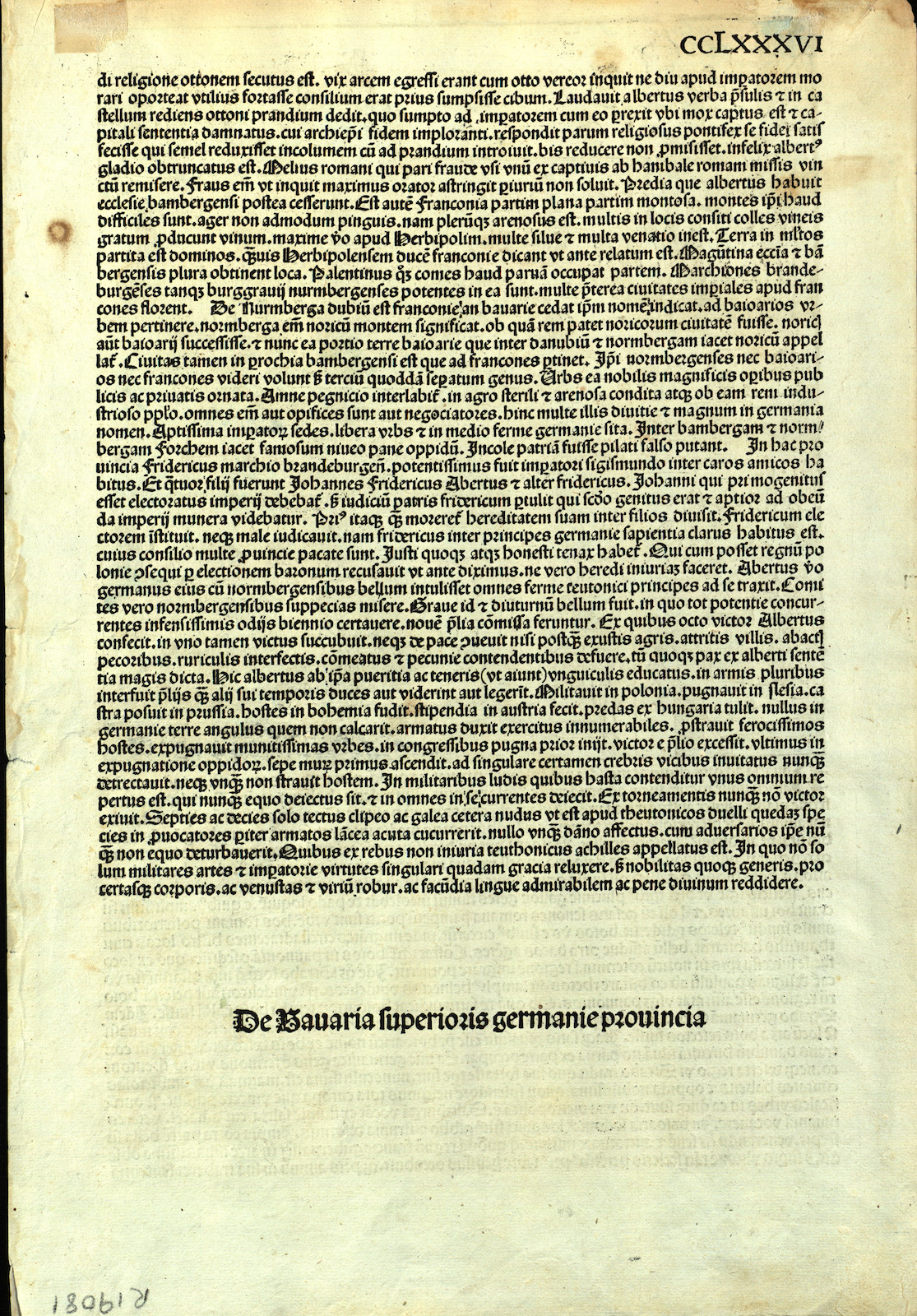
Recto and verso page CCLXXXVI of the Nuremberg Chronicle depicts the region of Bavaria, where Nuremberg is located. The Latin text describes the geography of Bavaria, the surrounding regions, and its cities and rivers. The main river that runs through Nuremberg is the Danube River, the second longest river in Europe at 1,777 miles (28,850 km), and drains into the Black Sea. The city of Nuremberg was a part of one of the major trade routes in the 15th century making it incredibly easy for agents to bring the most recent history the Nuremberg Chronicle holds to far and new lands. The ships coming in and out of the city could carry the book overseas while the land trade routes allowed the Nuremberg Chronicle to be transported to other neighboring cities and regions along the route.[1] The woodblock illustration emphasizes the Danube River flowing out to sea and carrying the massive cargo sailboats along with them. The tan buildings with red rooftops are all connected and surrounded by giant walls that sit on the shores in clusters spread equally across the illustration. This illustration renders the prosperous city Bavaria as full of wealthy, successful, and intelligent people.
The verso CCLXXXVI briefly states the story of Ludwig der Hockerige (in English, he's called Louis the Humpback or Louis VIII), who started a war against his father, Louis VII, who was once a governor in France. Louis VIII allied with his brother, Henry XVI, and surrounded Louis VII into a castle but as fate would have it, he fell ill with a fever and died before he could defeat his father.[2] Right before Louis VIII passed away, he made his wife, Blanche of Castile, the guardian for his children and reign of the kingdom in an attempt to assume the throne of England. Even with these plans set in place, there is no mention of Blanche in the royal documents. Ultimately because there is a male heir to take the throne after Louis VII, his brother, Henry XVI, succeeded in taking Bavaria-Ingolstadt instead.[3]
The recto side has the Roman numerals “CCLXXXVI” (286) listed in the upper right corner in a slightly larger type size than the body copy indicating the page number. The verso side has no Roman numerals indicating the page number. There is a box-bound woodcut block illustration centered near the top of the page. There are a variety of colors from bold reds, greens, yellows, and blues. At the bottom of the body copy, there are the words “de bauaria luperiors germaine prouincia” in a slightly bigger size than the body copy. This translates to “the German province of Bavaria.”
The overall page is 12 by 18 inches or (30 by 45 centimeters). The color of the paper is a slight light cream. There are three minimal rips in the center of the left side of the page. From top to bottom, there are three little tears along the edge. There is a little water damage on the left side of the page varying from the edge going all the way to the top. On the bottom of the left-hand corner, there is written in pencil “R19081” upside down.
Notes
[1] Toch, Michael. “Hauling Away in Late Medieval Bavaria: The Economics of Inland Transport in an Agrarian Market.” The Agricultural History Review 41, no. 2 (1993): 111–23.
[2] Adams, Tracy. “The Life and Afterlife of Isabeau of Bavaria.” (2010). Johns Hopkins University Press.
[3]Morse Library, Beloit College. “Nuremberg Chronicle: Folio CCLXXXVI verso.” Accessed May 4, 2022.
[4] Patkus, Ronald. “Never Before Has Your Like Been Printed: The Printing of the Nuremberg Chronicle: Background, Production, Legacy.” (2014). (This citation is missing in the body of the essay)
Bibliography
Adams, Tracy. “The Life and Afterlife of Isabeau of Bavaria.” (2010). Johns Hopkins University Press.
https://ebookcentral.proquest.com/lib/psu/reader.action?docID=4398335
Bisaha, Nancy. “Never Before Has Your Like Been Printed: The Nuremberg Chronicle of 1493.” (2014).
https://www.vassar.edu/specialcollections/exhibit-highlights/2011-2015/nuremberg-chronicle/essayexhibit.html
Morse Library, Beloit College. “Nuremberg Chronicle: Folio CCLXXXVII recto.” Accessed May 4, 2022.
https://digicoll.library.wisc.edu/cgi/t/text/text-idx?c=nur;cc=nur;view=text;idno=nur.001.0004;rgn=div2;node=nur.001.0004%3A11.42
Morse Library, Beloit College. “Nuremberg Chronicle: Folio CCLXXXVI verso.” Accessed May 4, 2022.
https://digicoll.library.wisc.edu/cgi/t/text/text-idx?c=nur;cc=nur;rgn=div1;view=toc;idno=nur.001.0004;node=nur.001.0004%3A1.
Patkus, Ronald. “Never Before Has Your Like Been Printed: Preface.” (2014).
https://www.vassar.edu/specialcollections/exhibit-highlights/2011-2015/nuremberg-chronicle/preface.html
Patkus, Ronald. “Never Before Has Your Like Been Printed: The Printing of the Nuremberg Chronicle: Background, Production, Legacy.” (2014).
https://www.vassar.edu/specialcollections/exhibit-highlights/2011-2015/nuremberg-chronicle/essayprinting.html
Toch, Michael. “Hauling Away in Late Medieval Bavaria: The Economics of Inland Transport in an Agrarian Market.” The Agricultural History Review 41, no. 2 (1993): 111–23.
https://doi.org/https://www-jstor-org.proxy.lib.pdx.edu/stable/40274956?seq=5