
Italian Letter



Italy, 1559
handwritten, ink on paper
height: 28.5cm
width: 21 cm
Language: Italian
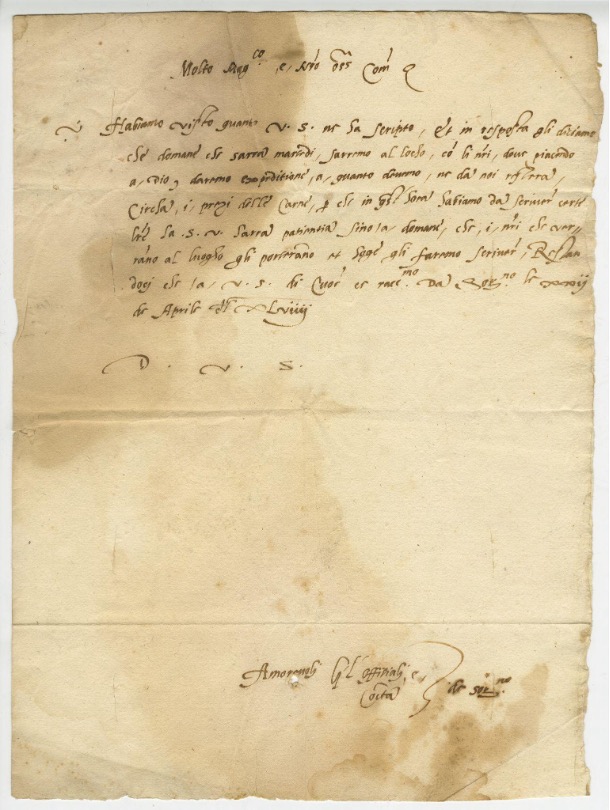
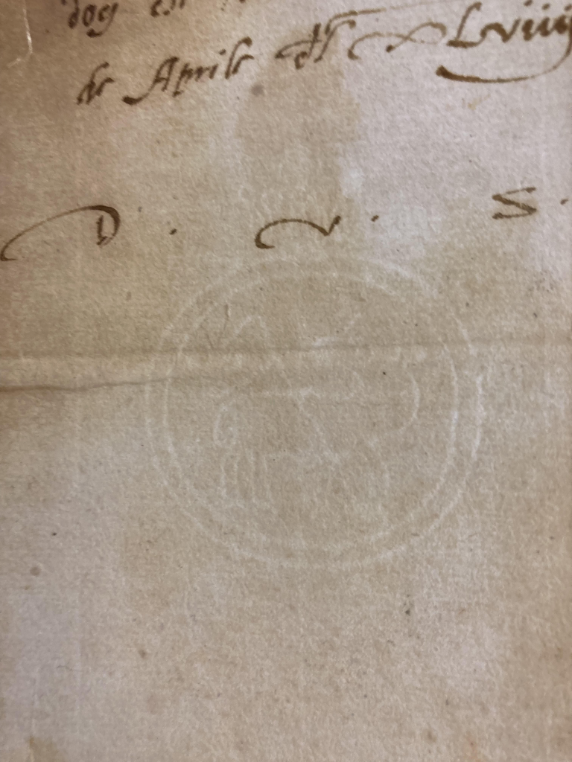
Dated 4/22/1559. Concerns Sor. Podesta. Written in Italian on a single sheet of laid watermarked paper with stains, the remnants of a seal, and a hole through the sheets. The watermark is a lamb carrying a flag within a circle and having a five-pointed crown on top.
Reed College Library Special Collections, Gift of Steven Herold
Samuel Barnack, Medieval Capstone Student, Spring 2023
Transcription:
[Front]
Molto magnifico e nostro oss Com q
Habiamo visto guanto V. S. ne ha scripto. Et in risposta gli diciamo che domane che
sarrà martedi, sarremo al lacho con li nostri, dove piacendo a Dio, daremo expeditione a
guanto devemo, ne dà noi resterà Circha i prezi delle carne, per che in gst horà habiamo
da scriver carte lrè ha S.V. harrà patientia fino la domane che i nostri che verrano al
luogho gli portirrano et soge gli faremo scrivere. Restandoci che a V. S. di Cuor ce
racemo.
Da Sorno le xxij de Aprile dc x lviiij.
D. V. S.
Amorevoli G.L. officiali e Communità
de Sorno
[Back]
Al molto magnifico Signor Podesta da Bassanello nostro molto oss
Translation:
[Front]
Most magnificent and our most respected __[1] etc…
We saw all that your lordship wrote. And in response we say to you that tomorrow–that will be Tuesday–we will be at the lake with our [people], where, God willing, we will deliver the shipment that we owe, and you will give us what’s left of it, based on the prices of the meats. Since at this time we must write letters, we hope your lordship will be patient until tomorrow, because tomorrow our [people] will come to the place with [the shipment], but today we [can only] write [to you].
We continue to wholeheartedly entrust ourselves to your lordship.
From Soriano The 22nd of April, [15]49.
Concerning your lordship
Lovingly, G.L. officials and community
of Soriano
[Back]
To the most magnificent lord podestà of Bassanello, our very most respected __
This short, 15th-century letter written in Italian is addressed to the podestà of a town near Viterbo called Bassanello (Vassanello) and is one of several documents from this town in Reed College Special Collections. Official letters like this were typical of the time, having greatly increased in the latter part of the 15th century.[2]
At the time the letter was written, Bassanello was in the Papal States, a polity under the rule of the Pope. In the late 15th and early 16th centuries, a series of popes worked to bring the region under more centralized rule.[3] This involved the replacement of signori (lords) with other, more papally-friendly signori–often loyal family and friends, and the assertion of the papal right to appoint some officials, including the podestà–occasionally translated as "mayor."[4] Although the 16th-century Papal States position of podestà was not the same as its high medieval predecessor, having different roles and under a higher degree of control by a central political entity,[5] the podestà as a concept was still tied to the commune.[6]
While the identity of the podestà addressed in this letter does not appear to be named, it may be worth considering what his ties may have been, since the appointment of a podestà or other official was often influenced by pressure from elites.[7] Other Bassanello documents in Reed College Special Collections clearly show that a branch of the papal della Rovere family was present and active in the matters of the commune.[8] Whether or not the podestà was a della Rovere or was in their circle, he would have had to frequently interact with them. The letter is addressed from the “officials and community of Soriano," which is presumably the town of Soriano (Soriano nel Cimino), several miles west of Bassanello. Giving credence to this identification is that the letter implies a distance short enough that the senders could reasonably expect to meet the recipients at a nearby lake “tomorrow.” The lake mentioned in the letter is likely no longer extant in modern times, because while there are several extant lakes nearby, all of them are far out of the direct path between the two communes. The lake may have been at Poggio del Lago (Lake Hill), a depressed area on the outskirts of Vasanello populated with lake vegetation, which has been claimed by some to be the site of a lake mentioned in Roman sources. Said lake is more commonly associated with the town of Bassano,[9] also near Bassanello and Soriano.
The letter regards a shipment of meat, which may have been intended for a feast or banquet, either private or public–an example of a public feast being the feast day of a local patron saint.[10] If it was intended for public purchase rather than a feast, it may have been sold at a market or shop,[11] or purchased by the town to aid in a shortage.[12] With the possible exception of beef, unprocessed meat was typically slaughtered on the day of consumption.[13] So if the shipment between towns did not involve live animals–which it does not appear to–then it is easy to assume that the meat was processed. Meat was eaten less frequently in early modern Italy than it is today, but it still comprised an important part of their diet. Beef was less common, and often imported, so it was typically more expensive than pork and mutton.[14] Game meat such as boar was also on the expensive side.[15] Pork was typically slaughtered and eaten in the fall and winter, while mutton was eaten in the spring.[16] Since this letter was written on April 22, mutton seems likely to have made up most of the meat in the shipment.
The letter is written in a swirly and clean Chancery hand, with a tilde marking the opening line of the body. The paper is folded in half and has creases that show that it was once further folded into an eighth of its current size, likely for its initial delivery, since the address and seal are not creased. It has a watermark in the form of a backward-looking Agnus Dei with a two-pointed banner, contained within a double rondel topped by a five-pointed crown. This watermark may also be present on another Bassanello document in Reed College Special Collections, written 5 years later,[17] though it apparently has a three-pointed crown rather than a five-pointed one. There is also an indentation and residual red wax from a seal on the back side of the letter.
Notes:
[1] Unclear, may be comissario, another type of official; Guido Castelnuovo, “Offices and Officials,” in The Italian Renaissance State, ed. Andrea Gamberini, Isabella Lazzarini (Cambridge: Cambridge University Press, 2012), 378.
[2] Castelnuovo, “Offices and Officials,” 382.
[3] Sandro Carrocci, “The Papal State,” in The Italian Renaissance State, ed. Andrea Gamberini, Isabella Lazzarini (Cambridge: Cambridge University Press, 2012), 84-5.
[4] Carrocci, “The Papal State,” 85.
[5] Carrocci, “The Papal State,” 85.
[6] Castelnuovo, “Offices and Officials,” 379-80.
[7] Carrocci, “The Papal State,” 87.
[8] E.g: I-0058-1551 [Land Document], I-0060-1554 [Business Document].
[9] Ardelio Loppi, “Vasanello Claims Location of Lake Vadimo," trans. Katrine Louise Moore, Associazione Culturale Poggio del Lago, 2009. http://www.poggiodellago.com/index.php/vasanello-il-lago-di-vadimone-the-lake-vadimo
[10] Elizabeth Cohen, Thomas Cohen, Daily Life in Renaissance Italy. 2nd Edition (Santa Barbara: Greenwood, 2019), 233.
[11] "Foodsellers and Markets." In The World of Renaissance Italy: A Daily Life Encyclopedia, ed. Joseph P. Byrne (Santa Barbara: Greenwood, 2017), 305-7.
[12] Cohen, Daily life in Renaissance Italy, 235.
[13] "Foodsellers and Markets," 305-7; "Meat, Fowl, Fish, Eggs, and Dairy." In The World of Renaissance Italy: A Daily Life Encyclopedia, ed. Joseph P. Byrne (Santa Barbara: Greenwood, 2017), 324-7.
[14] Christopher F. Black, Early Modern Italy: A Social History (New York: Routledge, 2001), 29, 52; Cohen, Daily Life in Renaissance Italy, 237.
[15] Cohen, Daily Life in Renaissance Italy, 237.
[16] Cohen, Daily Life in Renaissance Italy, 237.
[17] Box: 1, Folder: I-0060-1554, [Business Document] (1554).
Bibliography:
Black, Christopher F. Early Modern Italy: A Social History. New York: Routledge, 2001.
Byrne, Joseph P. ed. The World of Renaissance Italy: A Daily Life Encyclopedia. Santa Barbara: Greenwood, 2017.
Carrocci, Sandro. “The Papal State.” In The Italian Renaissance State, edited by Andrea Gamberini, Isabella Lazzarini, 69-89. Cambridge: Cambridge University Press, 2012.
Castelnuovo, Guido. “Offices and Officials.” In The Italian Renaissance State, edited by Andrea Gamberini, Isabella Lazzarini, 368-84. Cambridge: Cambridge University Press, 2012.
Cohen, Elizabeth, Thomas Cohen. Daily life in Renaissance Italy, 2nd Edition. Santa Barbara: Greenwood, 2019.
Loppi, Ardelio. “Vasanello Claims Location of Lake Vadimo." Translated by Katrine Louise Moore. Associazione Culturale Poggio del Lago. 2009.
http://www.poggiodellago.com/index.php/vasanello-il-lago-di-vadimone-the-lake-vadimo