
Saint Nicholas Orthodox Church


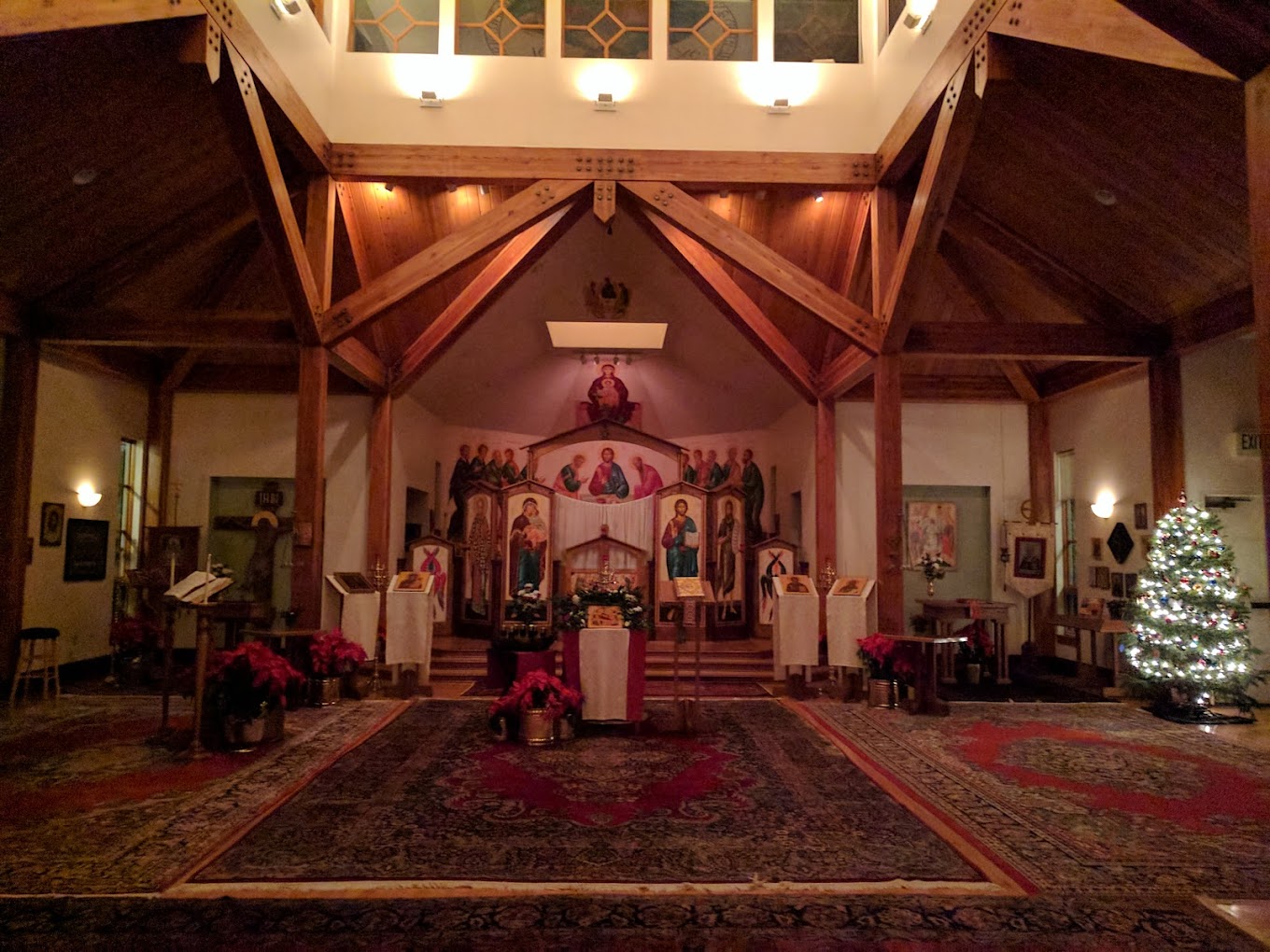

Byzantine-inspired architecture with Russian Orthodox elements and modern design
completed 1996
2210 SW Dolph Ct.
Portland OR 97219
Egg tempera icons by Heather MacKean
Josh Hester, Medieval Portland Capstone Student, Spring 2024
St. Nicholas Orthodox Church exemplifies Byzantine-inspired architecture in the Pacific Northwest, blending traditional Russian Orthodox elements with modern urban design.[1] The church transitions away from the use of onion domes prevalent in traditional Russian architecture "as to not exclude any particular ethnic sort of Orthodoxy," while maintaining a traditional cross-in-square layout—enhancing the aesthetic appeal and reinforcing its role as a spiritual and cultural hub.[2] The cross-in-square floor plan, reflecting a fusion of indigenous Russian building techniques with profound Byzantine influences, flourished from the 10th to the17th centuries. The structural design, distinguished by a centralized dome, was "meant to focus attention on the space immediately beneath it."[3]
The St. Nicholas building is supported by a complex system of arches and pendentives, hallmarks of the architectural influence of the era. The cupola—symbolizing spiritual ascent and the divine, underscores the church’s deep roots in Orthodox tradition. Upon entry, the narthex—or entry vestibule—is "designated… for special functions, such as baptisms,"[4] and welcomes the congregation into the naos—the church’s primary worship space. Featuring a squared floor plan centered around a dome, St. Nicholas creates a "directional ambivalence in the interior"[5] harkening back to traditional Byzantine-inspired layouts focused on the separation of performance areas, "a cohesive yet never oppressive visual language… that helped define the Northwest Modern style."[6]
The influence of Pietro Belluschi (1899-1994)—renowned for his role in designing the Portland Art Museum—is distinctly evident throughout. The modernist approach and skillful integration of natural surroundings enhance functionality and aesthetics, elevating traditional Russian construction methods through locally sourced materials. This structure embodies a seamless connection of place-based architecture while creating a spiritually significant and environmentally integrated landmark. "Resulting in a lavishly decorated and carefully arranged image of Heaven, the cosmos, or of the Holy land—a symbolically flexible framework whose meaning shift[s] with the ceremonies it house[s]."[7] This marriage of modernism and nature underlines shaping spaces rooted in tradition—yet forward-thinking.
Internally, the spiritual ambiance is profoundly enriched by the artistic contributions of Heather MacKean, who utilizes the traditional egg tempera painting method to create her Eastern Orthodox icons. This method, which predates oil painting, involves a meticulous process of mixing pigments with egg yolk and water, a technique that hails from the early Christian periods of Byzantine art. MacKean’s mastery of this ancient technique allows her to create icons that are not only visually striking but also imbued with deep theological significance, inviting "the Spirit of God (to speak from) behind the lines and colors, telling the worshipper things a critic cannot see."[8] Her work at the church includes pivotal pieces such as The Communion of the Apostles, located in the apse, The Theotokos with Christ, and The Holy Trinity. Additionally, the iconostasis features her renditions of Saint Nicholas, the Four Evangelists, and Christ the Pantocrator in the dome. These icons transcend mere decoration and are vital to the church’s liturgical functions and theological teachings, deeply rooted in Eastern Orthodox art and theological traditions.
Known for its universally inviting atmosphere, diverse membership, unique iconography, and traditional Byzantine-inspired architectural design, St. Nicholas exemplifies the ideal that growth does not need to hinder tradition. The iconographic elements create a comprehensive narrative that educates, inspires, and deepens the congregation’s faith.[9] By engaging with these icons during worship, the faithful participate in a visual and spiritual dialogue that bridges Heaven and Earth, intertwining the divine with the daily lives of the church’s community. This immersive environment beautifies the church and serves as a constant source of theological reflection and spiritual enrichment.
St. Nicholas is a testament to the enduring legacy of Byzantine architecture within the Orthodox Church, continuously serving as a beacon of faith and cultural heritage. This integration of medieval-inspired architectural styles with contemporary needs and Russian Orthodox traditions ensures the church remains a vibrant center of community life: bridging the past with the present while fostering a dynamic engagement with the rich traditions of the Orthodox faith.
Notes
[1] Heather MacKean, interview by Josh Hester, May 2-9, 2024.
[2] G. Gray, interview by Josh Hester, May 14, 2024.
[3] Robert Ousterhout, Master Builders of Byzantium (Princeton: Princeton University Press, 1999).
[4] Ousterhout, Master Builders of Byzantium.
[5] Ousterhout, Master Builders of Byzantium.
[6] Brian Libby, "Belluschi at His Most Breathtaking: Visiting Saint Mary’s Cathedral in San Francisco," Chatterbox, November 2019.
[7] Outserhout, Master Builders of Byzantium.
[8] Heather MacKean, Galleries: Churches, colored photographs, HeatherMacKean. Accessed May 4, 2024. https://heathermackean.com/Churches/index.html.
[9] Author Unknown, "Icons," accessed May 7, 2024, https://www.orthodox-icon.com/icons.
Bibliography
Author Unknown. "Icons." Accessed May 7, 2024. https://www.orthodox-icon.com/icons.
Carleton Hart Architecture. "St. Nicholas Church." Accessed May 2024, https://www.carletonhart.com/st-nicholas-church.
Libby, Brian. "Belluschi at His Most Breathtaking: Visiting Saint Mary’s Cathedral in San Francisco." Chatterbox, November 2019. https://chatterbox.typepad.com/portlandarchitecture/2019/11/belluschi-at-his-most-breathtaking-visiting-saint-marys-cathedral-in-san-francisco.html.
MacKean, Heather. Galleries: Churches. Colored photographs. HeatherMacKean. Accessed May 4, 2024. https://heathermackean.com/Churches/index.html.
Robert Ousterhout. Master Builders of Byzantium. Princeton: Princeton University Press, 1999.