
Book of Hours Leaf


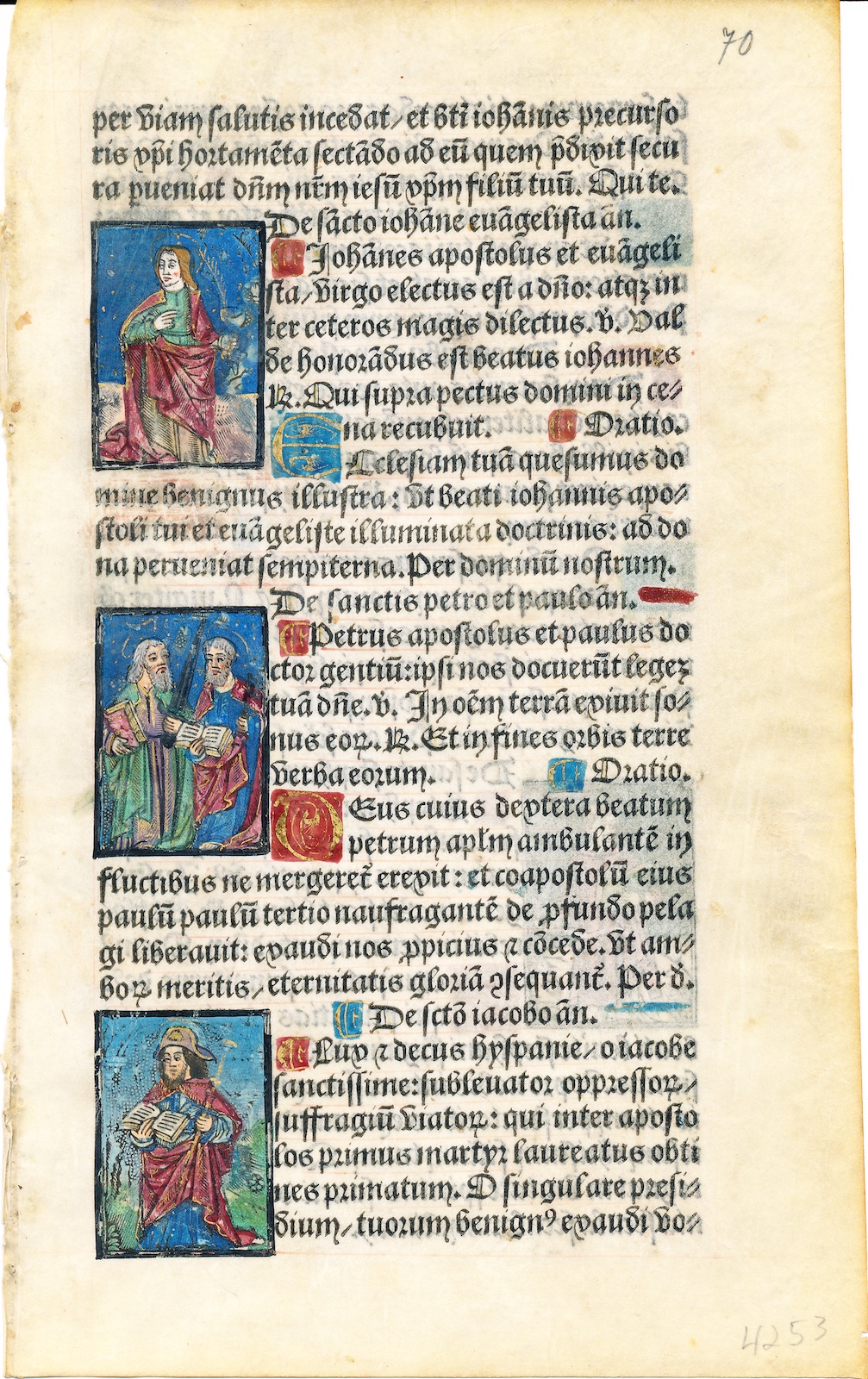
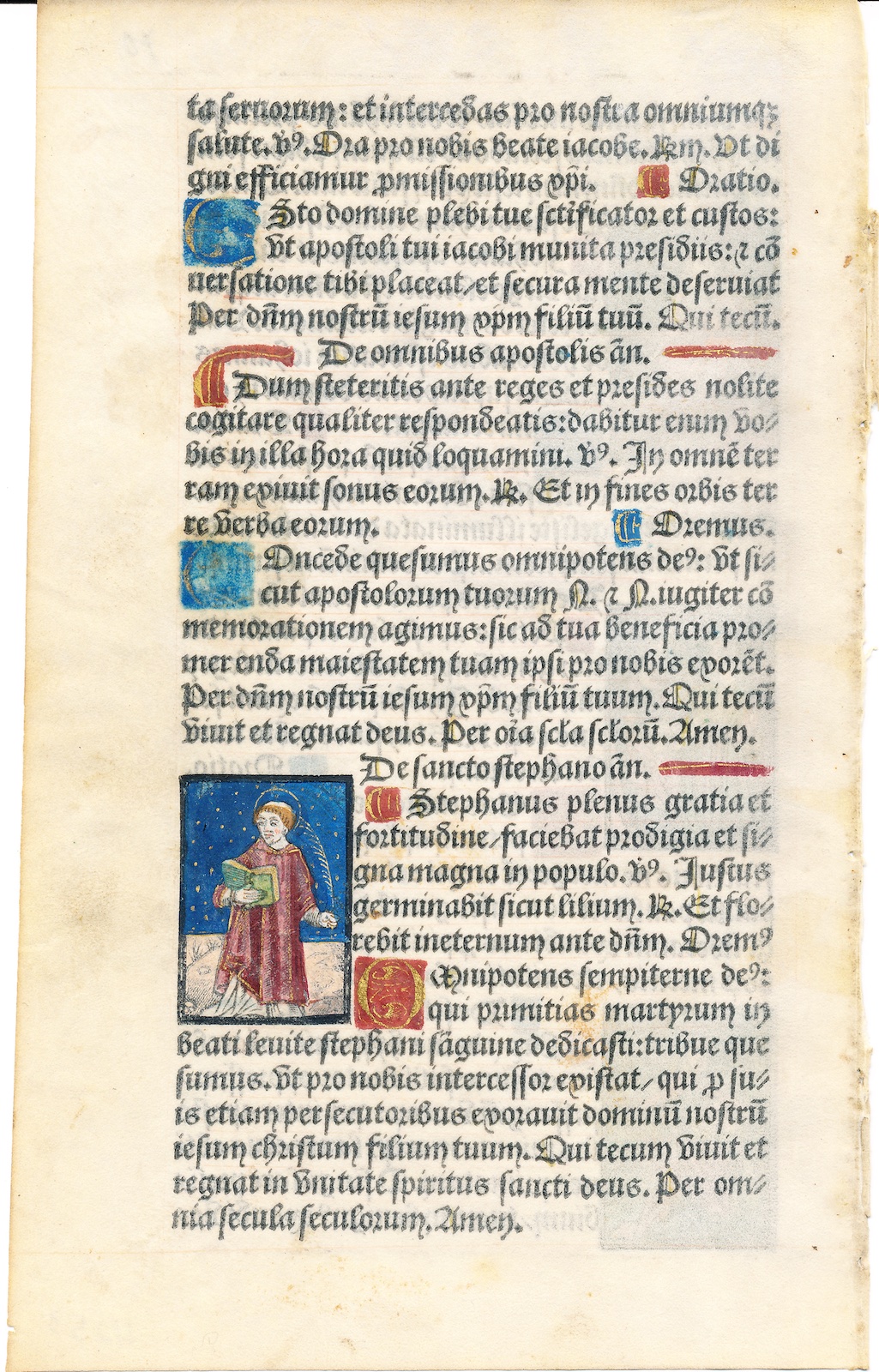
Paris, ca. 1500
Printed by Hardouyn Brothers (Gilles/Gillet and Germain)
Language: Latin
Single leaf from a printed Book of Hours
ink on vellum
Portland State University Library Special Collections, Mss 42
Gift of A. Gordon Hunter
Charity Waters, Medieval Portland Capstone Student, Spring 2023
This leaf from the Book of Hours would have been in the suffrage section. Both recto and verso sides comprise 33 lines in a singular column. The four engraved images of Saints John, Peter, Paul, and James on the recto side and Stephen on the verso, with hand-illuminated initials are present. This leaf was printed by the Hardouyn brothers, who soon became a large part of the printing industry, surpassing leading printer Antoine Vérard.[1]
Suffrage
The suffrage section often was placed near the end of books of hours and comprised a set of short prayers to saints. Each section summarizes the life of a saint and follows a specific order: the antiphon, the versicle, followed by the response, and ending with a prayer to the martyr and their death.[2] The suffrage is categorized in hierarchical order, following the mirror image for the hierarchal order in Heaven.[3]
The suffrage part of the book of hours is highly customizable, the patron can choose to have no images or pick which saints they choose to include.[4] The verso side of this page was customized as this page omits Saint Andrew the Apostle and picks up at “all of the Apostles,” followed by Saint Stephen.
Images
Each image depicts a different saint. The first, Saint John depicts him holding a wine glass with two fingers present in front of his chest holding a wine glass. While the original story said that Saint John was given a poisoned glass of wine and then restored life to everyone the poison had killed., thus he became a symbol of prevailing over death.[5]
The second image is of Saints Peter and Paul. Peter is depicted holding either a shepherd's staff or a set of keys in his left hand and a book in his right. The shepherd staff represents Peter's role as leader of Jesus's Flock, while the keys represent his acceptance into holding the keys to the kingdom.[6] Paul is depicted holding a large black knife in his left hand and a book in his right. Both Peter and Paul are shown here together as they often are, both becoming martyrs on the same day. This symbolizes their symbiotic relationship in the Christian faith.
Saint James is depicted holding a staff in his left hand and a book in his right, wearing a hat, which is the most prevalent depiction of Saint James.[7] The verso side of the page depicts Saint Stephen holding a quill pen on his left and a book on his right. Saint Stephen was the first martyr under the New Testament and was considered a saint who looked over widows and the solver of problems.[8]
The images have multiple uses, from aiding the faithful's path to absorption into their prayer to also being text markers--functioning similarly to that of headings.[9]
Condition
The condition is an aged page with yellowing across the entire paper, with browning present across the border.
Notes
[1] Rienburg, “Culture and Commerce” 15.
[2] Harvard College, “Picturing Prayer.”
[3] Rienburg, “A Fragment of Religion,” 173.
[4] Stein, “The Book of hours: A Medieval Bestseller.”
[5] De Voragine, “The Golden Legend: Readings on the Saints” 50
[6] De Voragine, “The Golden Legend: Readings on the Saints” 340
[7] Stein, “The Book of hours: A Medieval Bestseller.”
[8] De Voragine, “The Golden Legend: Readings on the Saints”45.
[9] Stein, “The Book of hours: A Medieval Bestseller.”
Bibliography
Wendy A. Stein. “The Book of Hours: A Medieval Bestseller.” The Metropolitan Museum of Art’s Heilbrunn Timeline of Art History, January 1, 1AD.
https://www.metmuseum.org/toah/hd/hour/hd_hour.htm.
De Voragine, Jacobus. The Golden Legend: Readings on the Saints. Princeton University Press, 2012.
Reinburg, Virginia. French Books of Hours: Making an Archive of Prayer, C.1400-1600, 2012.