
Kerver Bible



1534
Kerver Publishing House, Paris, France
Published by Yoland Bonhomme (widow of Thielman Kerver)
Height: 6 in
Width: 4 1/4 in
Depth: 2 1/8 in
Portland State University Special Collections, BS75 1534
Shea Dancey, Medieval Portland Capstone Student, Spring 2024
This 1534 Bible, published by Yolande Bonhomme, is one of the earliest Latin Vulgate Bibles printed by a woman. It was produced in the Kerver publishing house that was established by Bonhomme’s husband, Thielman Kerver, and inherited by her after his passing in 1522. This book contains three full-page woodblock prints and the artist that was contracted to create the illustrations is unknown.[1]
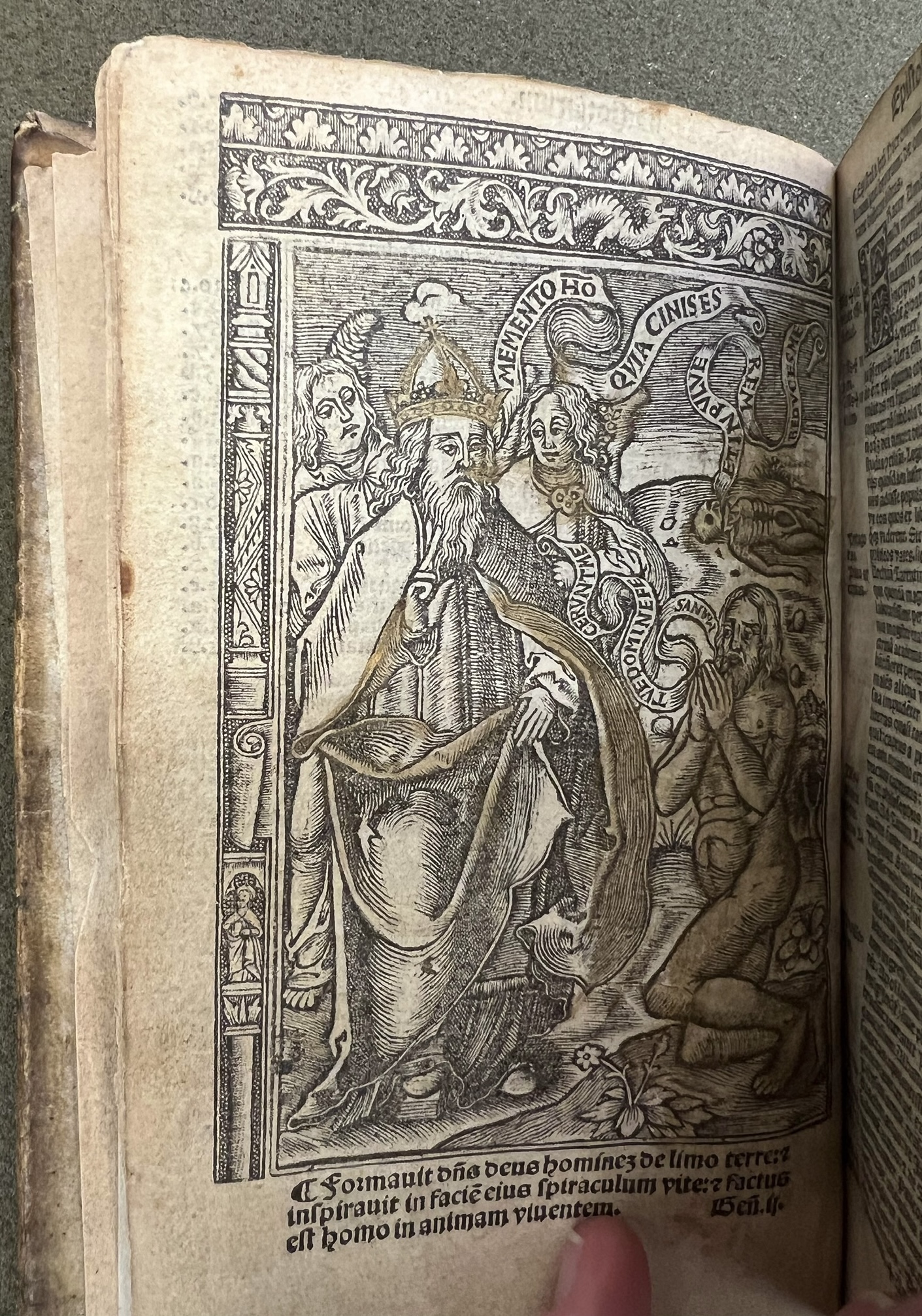
These images exemplify medieval woodcut designs with their bold outlines and shadows formed by parallel lines. The first illustration in Bonhomme’s bible depicts the Creation of Adam from the Book of Genesis. It captures the moment after creation when a nude Adam kneels with his hands clasped before God, who is accompanied by two angels. The image is captioned with text from chapter two of Genesis, which describes how Adam was formed from the earth and brought to life with the breath of God. The page is colorless except for accents of gold leaf. The bodies of Adam and a corpse are covered in gold along with God’s crown, the folds in his robes, and his breath.
The Genesis image in Bonhomme’s bible is comparable to the illustration of the Creation of Adam in the Liber Chronicarum (Nuremberg Chronicle) from 1493.[2] Both woodblock illustrations show a newly formed Adam before God. Their representations of God reflect a late-medieval European preference for depicting God as a bearded, elderly man.[3] He also wears robes, with his right hand raised in a gesture of blessing. In the Nuremberg Chronicle, God’s status is reinforced through an intricate quatrefoil brooch on his robes. Bonhomme’s portrayal of God showcases more overt royal or clerical aesthetics with his headpiece resembling a crown or mitre, especially with its crosses and fleur-de-lis.[3] While the Nuremberg Chronicle presents Adam alongside the other animals that God created, Bonhomme’s bible places Adam next to a skeleton. This highlights the contrast between life and death and juxtaposes the process of creation with the process of decay.
The book also includes an illustration of the Tree of Jesse from the Book of Isaiah. In this scene, Jesse of Bethlehem lies in bed with a tree growing from his chest. The tree shows the genealogy of Christ and includes notable figures such as David, Solomon, Ala, and Abia. An identical print appears in the 1507 version of the Kerver Book of Hours, also in the PSU Special Collections, demonstrating that Bonhomme reused woodblocks from her husband.[5] In Bonhomme’s bible, gold around the figures’ crowns emphasizes their status and power. At the top of the tree is the Virgin Mary with the Christ Child. The representation of the Virgin reflects her significance within medieval theology as the epitome of purity and motherhood.[6] In this illustration, Mary and Jesus are surrounded by gold halos and a mandorla. Like the image from Genesis, the people on this page are rendered in medieval European styles of dress. By doing this, the artist makes these figures and their moral messages seem more familiar and relatable to a medieval audience.[7]
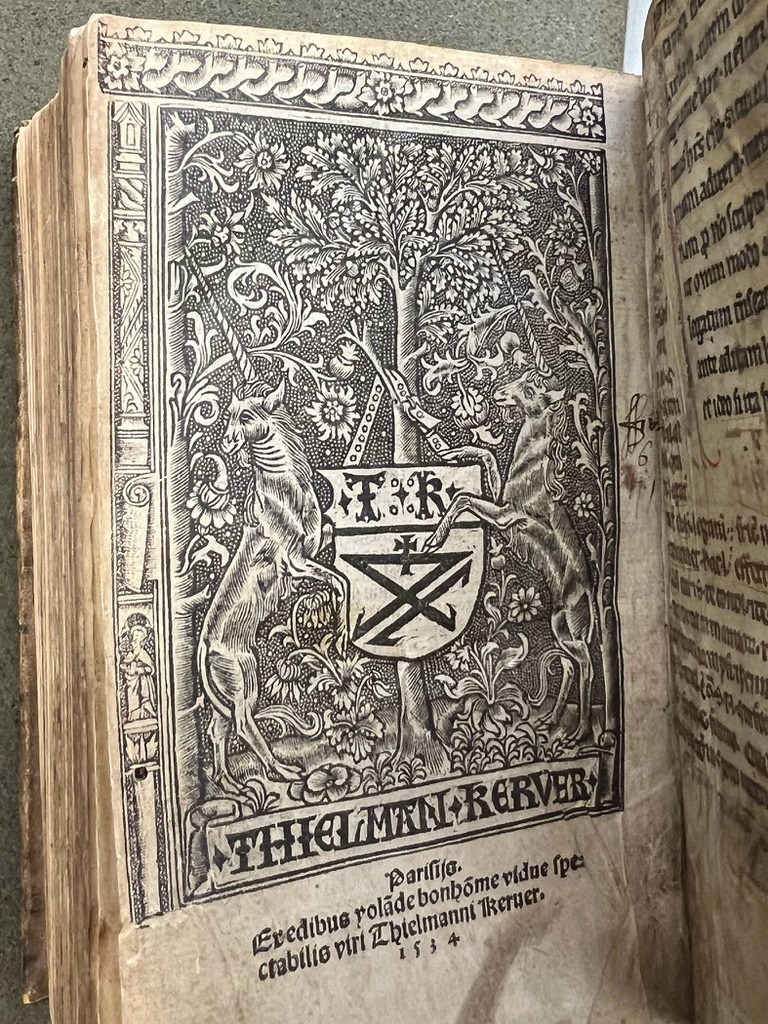
At the end of the book is the printer’s mark of the colophon. This includes an image of two unicorns around a crest in a forest against a criblé (dotted) background. The unicorns are the symbol of the Kerver publishing house that Bonhomme continued to use after her husband’s death. They are partially a nod to the fact that the business was in the Hotel of the Unicorn in Paris.[8] Thielman Kerver’s name is at the bottom of the illustration and the crest between the unicorns has his initials: T.R. Below the image is an inscription acknowledging Bonhomme as Kerver’s wife and heir as well as the year of publication, 1534. At the front of the book is a facsimile of the title page from Bonhomme’s 1526 bible.[9] It has the same image of the unicorns and is accompanied by Latin text giving information about the Vulgate. The fact that the image originates from another text is evidenced by how the margin illustrations differ from the other pages in the 1534 bible.
The images in Bonhomme’s bible are all surrounded by borders filled with sculptural, foliage, and monster designs. Although unrelated to the contents of the images, the margin illustrations visually captivate the viewer. They are less complex compared to the ones in books such as the 1507 Kerver Book of Hours, which feature margins that show episodes from the Bible, including the Passion of Christ and the Book of the Apocalypse. Nonetheless, the margins in Bonhomme’s bible provide insight into the cultural and artistic context in which the woodcuts were produced.[10] Recurring imagery between the borders of the different images indicates that the creation process for these pages involved combining multiple woodblocks together rather than using singular pieces. The repetition of motifs creates a sense of unity between the illustrations and cultivates a distinct visual identity for Bonhomme’s 1534 bible.
Notes
[1] Beatrice H. Beech, “Yolande Bonhomme: A Renaissance Printer,” Medieval Prosopography 6, no. 2 (1985), https://www.jstor.org/stable/44946027.
[2] Hartmann Schedel, Liber Chronicarum (Nuremberg: Anton Koberger, 1493), https://medievalportland.org/digital-heritage/nuremberg-chronicle-leaf-liber-chronicarum-leaf-1.
[3] Barbara Newman, “Intimate Pieties: Holy Trinity and Holy Family in the Late Middle Ages,” Religion & Literature 31, no. 1 (1999), http://www.jstor.org/stable/40059761.
[4] Newman, “Intimate Pieties.”
[5] Thielman Kerver, Book of Hours (Paris: Kerver Publishing House, 1507), https://content.library.pdx.edu/files/PDXScholar/Kerver-Book-of-Hours-1507/108/.
[6] Jonathan J. G. Alexander, “Iconography and Ideology: Uncovering Social Meanings in Western Medieval Christian Art,” Studies in Iconography 15 (1993), http://www.jstor.org/stable/23923571.
[7] Alexander, “Iconography and Ideology.”
[8] Beech, “Yolande Bonhomme.”
[9] Yolande Bonhomme, Vulgate Bible (Paris: Kerver Publishing House, 1526), https://numelyo.bm-lyon.fr/f_view/BML:BML_00GOO0100137001101163991/IMG00000009
[10] Lucy F. Sandler, “The Study of Marginal Imagery: Past, Present, and Future,” Studies in Iconography 18 (1997), https://www.jstor.org/stable/23924068.
Bibliography
Alexander, Jonathan J. G. “Iconography and Ideology: Uncovering Social Meanings in Western Medieval Christian Art.” Studies in Iconography 15 (1993): 1-44. http://www.jstor.org/stable/23923571.
Beech, Beatrice H. “Yolande Bonhomme: A Renaissance Printer.” Medieval Prosopography 6, no. 2 (1985): 263-312. https://www.jstor.org/stable/44946027.
“Bible in Latin (Vulgate), Kerver, Bonhomme, 1534.” Patrick’s Rare Books. www.patricksrarebooks.com/product-page/bible-in-latin-vulgate-kerberos-1534.
Bonhomme, Yolande. Vulgate Bible. Paris: Kerver Publishing House, 1526. https://numelyo.bm-lyon.fr/f_view/BML:BML_00GOO0100137001101163991/IMG00000009.
Kerver, Thielman. Book of Hours. Paris: Kerver Publishing House, 1507. https://content.library.pdx.edu/files/PDXScholar/Kerver-Book-of-Hours-1507/108/.
Newman, Barbara. “Intimate Pieties: Holy Trinity and Holy Family in the Late Middle Ages.” Religion & Literature 31, no. 1 (1999): 77–101. http://www.jstor.org/stable/40059761.
Sandler, Lucy F. “The Study of Marginal Imagery: Past, Present, and Future.” Studies in Iconography 18 (1997): 1-49. https://www.jstor.org/stable/23924068.
Schedel, Hartmann. Liber Chronicarum. Nuremberg: Anton Koberger, 1493. https://medievalportland.org/digital-heritage/nuremberg-chronicle-leaf-liber-chronicarum-leaf-1.