
Nuremberg Chronicle Leaf | Liber Chronicarum



1493
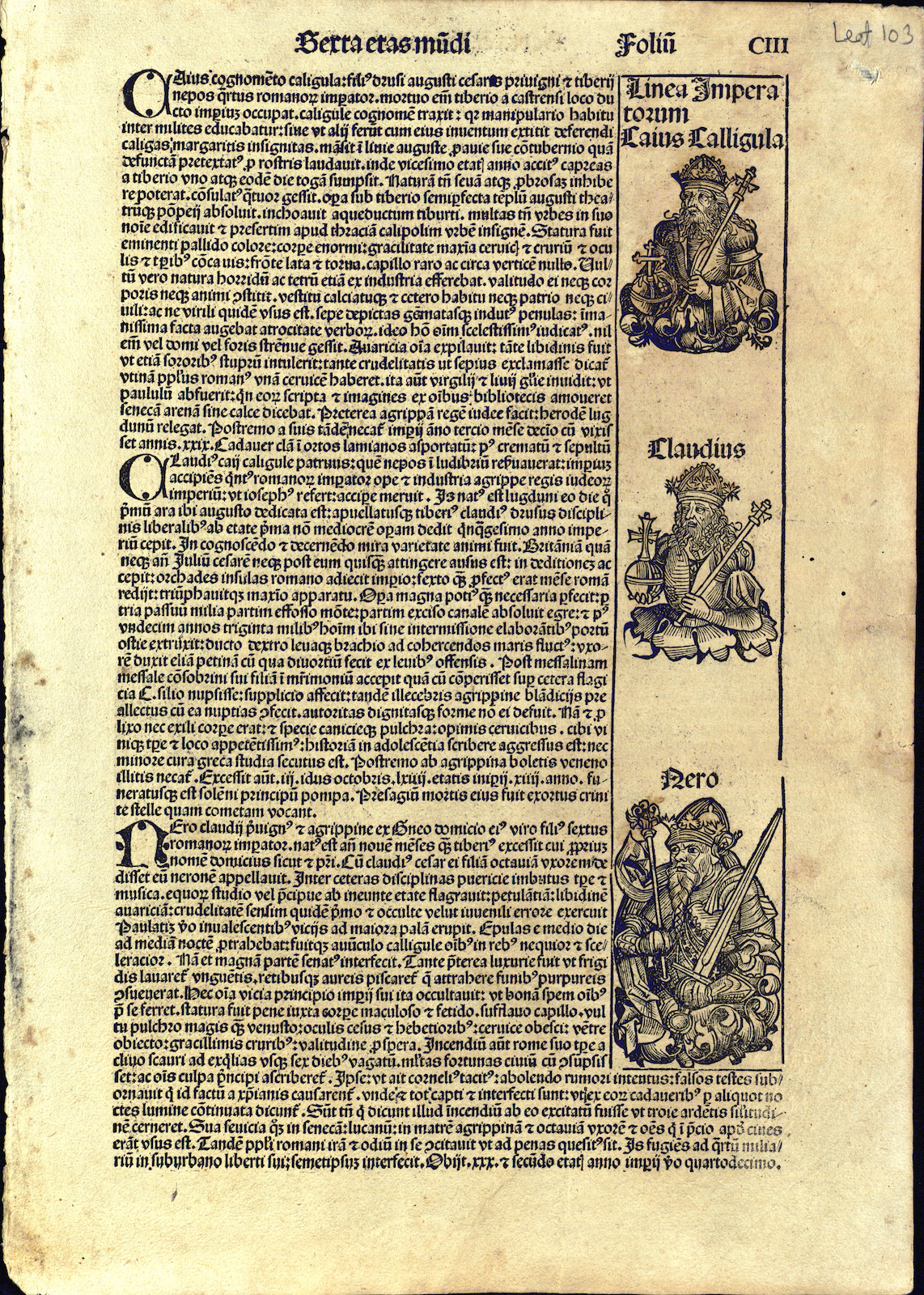
Recto and verso featuring the stories of saints Stephen and Paul, and the reins of Roman emperors Caligula, Claudius, and Nero
Language: Latin
Portland State University Library Special Collections
Gift of Dr. Joe H. Rosenthal to the Harold Schnitzer Family Program in Judaic Studies
Marcelo Franca, Medieval Portland Capstone Student, Spring 2022
Folio CIII in the Nuremberg Chronicle (1493) outlines the biblical stories of saints Stephen and Paul. It also covers the reins of emperors Caligula, Claudius, and the infamous Nero. In the medieval period, Nero was remembered for his cruel and tyrannical persecution of Christians. What is particularly interesting is that medieval writers tip-toed around his death by suicide-- although the Nuremberg Chronicle does. This is likely due to the ethical and theological doctrine concerning suicide at this time. Medieval texts such as this Chronicle thus did not recall his achievements, like liberating Greece.
The verso begins with a detailed description of the first martyr of Christianity, Stephen, who was an elected official of the deacon and a servant of the Faith. It is said that his face appeared unto the Jewish people who opposed him as that of an angel. [Acts 7:15] During a debate with Diaspora Jews, his words offended the group so much that he was accused of blasphemy. These very opposers, the Sanhedrin, eventually arrested him and put him on trial. His two defenses were even more outrageous to the Jews in that God did not limit his favor to the Holy Land or to the Temple, and that the Jews had always attributed a narrow bigoted spirit to their God. Enraged, the mob dragged Stephen from the city and stoned him to death.
In the thirteenth century, roughly 200 years before the Nuremberg Chronicle’s publishing, the church decided to put the Talmud on trial. The Talmud a collection of Jewish experience in all aspects of their life and culture, but the Christians believed it to be a text that was attempting to rival the Old Testament’s role in Jewish philosophy. Pope Gregory IX wrote in a letter, “For they (the Jews), so we have heard, are not content with the Old Law which God gave to Moses in writing: they even ignore it completely.” The Christians feared that if the Jews accepted the Talmud as the superior text of Judaism, their role as witnesses to the legitimacy of the Old Testament would be erased. This meant that the Jews had no place in the medieval world, and given the staged nature of this trial, the Talmud texts were seized and burned a full year after the “trial.”
Conversion of Saul
Saul, who later became Paul, was present at the stoning of Stephen, even holding the clothes of those who were casting stones. On a journey to Damascus, he is confronted by God, who asks why he persecutes him, and this supernatural event inspired him to convert to Christianity.
Bibliography
Cartwright, Steven R, and C. Colt Anderson. 2013. A Companion to St. Paul in the Middle Ages. Leiden ; Boston: Brill. (Cartwright and Anderson 2013, St. Paul and Reform Rhetoric- pages 325-348)
Cropp, Glynnis M. 2007. “Nero, Emperor and Tyrant, in the Medieval French Tradition”. Florilegium 24 (January):21-36. https://journals.lib.unb.ca/index.php/flor/article/view/12562.
Kara Ann Morrow. 2007. Beyond the Yellow Badge : Anti-Judaism and Antisemitism in Medieval and Early Modern Visual Culture. Edited by Mitchell Merback. Leiden ; Boston: Brill. (Kara Ann Morrow 2007, Disputation in Stone: Jews Imagined on the Saint Stephen Portal of Paris Cathedral- pages 63-86)
“Nuremberg Chronicle: FOLIO CIII Verso.” n.d. Digicoll.library.wisc.edu. https://digicoll.library.wisc.edu/cgi/t/text/text-idx?c=nur.
“Nuremberg Chronicle: FOLIO CIII Recto.” n.d. Digicoll.library.wisc.edu. https://digicoll.library.wisc.edu/cgi/t/text/text-idx?c=nur.