
Nuremberg Chronicle Leaf | Liber Chronicarum


1493
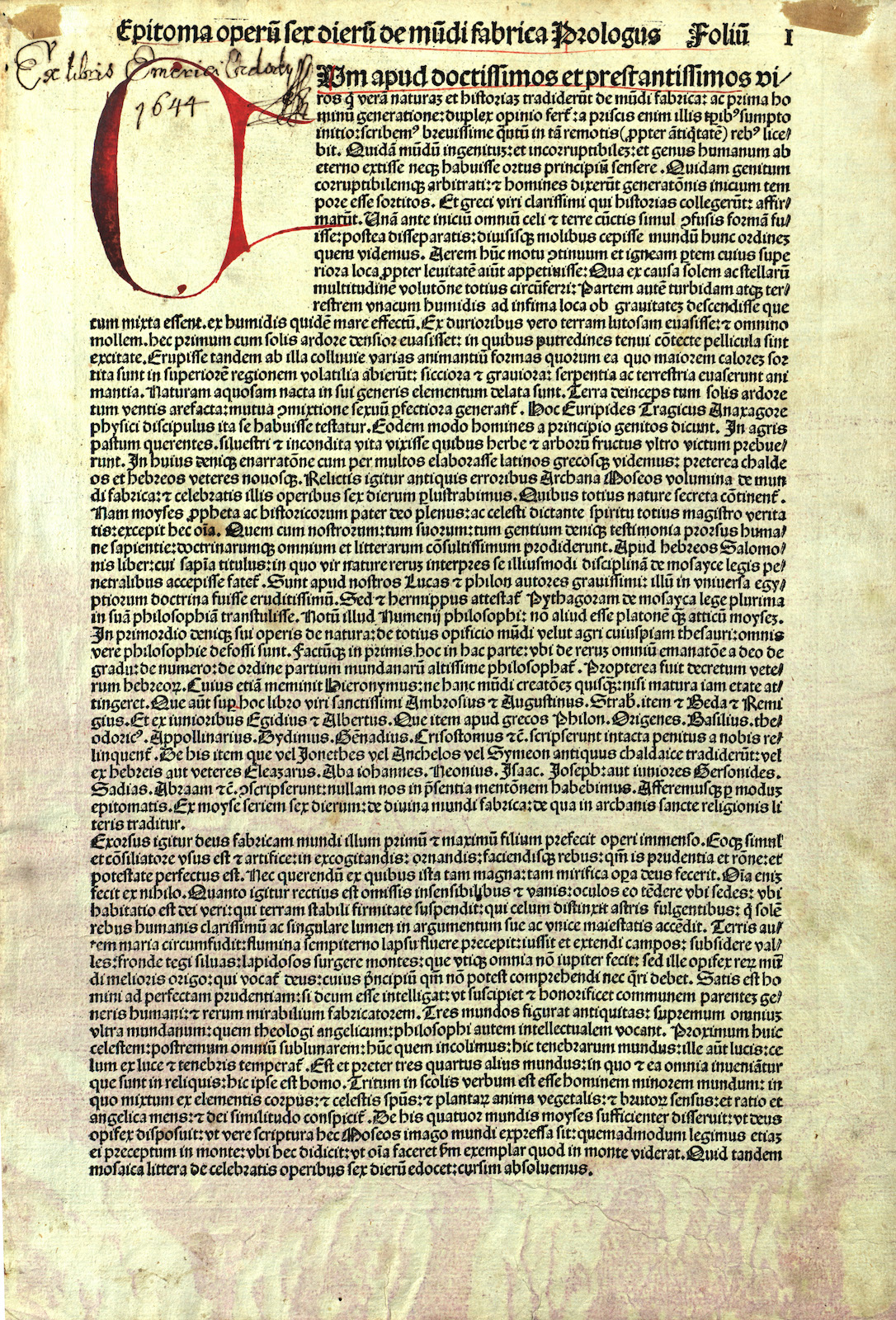
Recto: Opening text of with initial in red
Verso: God the Father Enthroned
Language: Latin
Illuminated in color
Portland State University Library Special Collections
Gift of Dr. Joe H. Rosenthal to the Harold Schnitzer Family Program in Judaic Studies.
Taylore Ranslow, Medieval Portland Capstone Student, Spring 2022
Folio I verso
This page opens the Nuremberg Chronicle with the image of “God the Father Enthroned.” Following the biblical book of Genesis, it retells the step-by-step creation of the moving and living components of the world, with a secondary account more reliant on medieval science to explain that “those who had received more heat became winged creatures and soared into the upper regions; but the drier and heavier ones became crawling and earthly animals.” This folio is overall in good condition. There are red-purple splotches around the bottom edges of both sides, stains not unlikely to be wine. Brown spots also appear on the surface occasionally as well as dark, circular later marks.
The escutcheons held at the bottom of “God the Father Enthroned” are left blank intentionally; meant to be customized upon purchase, it is not a mistake that these canvases are some of the only white spaces we can observe within the illustration’s border. It is likely that the only owners of a page like Folio 1, which is made to be customized, would be a family of enough status to afford such a piece and have the purpose and ability to inscribe their own image on it.
The beastly men who hold these escutcheons remain more mysterious than the blank canvases themselves. At first glance, they resemble and even mimic the traditional poses of animals seen in the art of heraldry, or the design of armorial bearings. The image of two lions on either side of a dressed up escutcheon, perhaps standing tall with their large paws outstretched and their mouths open in a collective roar might be familiar to us in popular culture as a typical icon painting the front of a shield.
Several images in the Nuremberg Chronicle’s “God the Father Enthroned” are reminiscent of earlier medieval imagery, such as with upraised right hand in the recognizable position of blessing, and left hand grasping the symbolic orb of the world. This image in the Nuremberg Chronicle, of the Creator holding a symbol of the world in His palm, brings forth the sentiment of God’s total control, an idea in harmony with the text on the verso that details the Biblical account of the creation of the world by God the Father, “for He made all things out of nothing… hung up shining stars in the heavens, distinguished the clearest suns, surrounded the earth with the sea…”
This hierarchy of creation, expanded upon in following folios of the late medieval Chronicle, ranks angels as highest of God’s created beings, then humankind, followed by the animals that inhabit earth. But what does it mean for a hybrid of these beings to exist? Since the Bible does not outline the creation nor positional hierarchy of half-beast, half-human creatures, the very existence and promotion of such a being could contradict the Christian world-origin story and grant as much power of creation as God has. In the Nuremberg Chronicle’s “God the Father Enthroned,” a distinct polarization is depicted between the heavenly plane— where angels inhabit the “upper branches”— and a conceivably lower, earthly plane with
creatures that are half-beast, half-man; poised and ready with weapon and shield.
Images of half-beast, half-human figures at the bottom of “God the Father Enthroned” would likely have been cut for heretical content had it not been for the consideration of unknown beasts by St Augustine of Hippo, a theologian of the fourth and fifth centuries whose writings were popular in medieval churches. While keeping the idea that “God is supreme being, that is, He created all out of nothing,” Augustine also subscribed to the order that “to some things He gave more of being and to others less and, in this way, arranged an order of natures in a hierarchy of being,” language that intimately reflects the same notions of ordered hierarchy in creation by much later medieval scholars, and repeated in the Nuremberg Chronicle. Thus, Augustine concluded that any existence of unknown beasts and half-human hybrids must be a creation by the same God, as He can act “without any impediment, difficulty, or prohibition arising from any ‘law of nature.’” This places the beast-men in accordance with the Genesis account of the world’s creation.
The appearance of the beast-like men connects with the only text in the image, an excerpt from Psalm 32 in the Bible that recalls the power of God’s word to speak anything into existence— “For He spake, and it was done; He commanded and it stood fast,”9. God is the one to speak all of these things into existence, both the typical and atypical; the named and unnamed. This page, while referencing popular art styles and mediums of the fifteenth century, recalling biblical and religious as well as secular history, and utilizing nuance in image to apply it to the human history the artist saw around them, represents what much of the Nuremberg chronicle strove to print on the page, and encapsulates what was found important to keep in this book of records.
Bibliography
Lindquist, Sherry C.M. and Asa Simon Mittman. 2018. Medieval Monsters: Terrors, Aliens, Wonders. The Morgan Library & Museum.
St. Augustine, “City of God.”