
Nuremberg Chronicle Leaf | Liber Chronicarum



1493
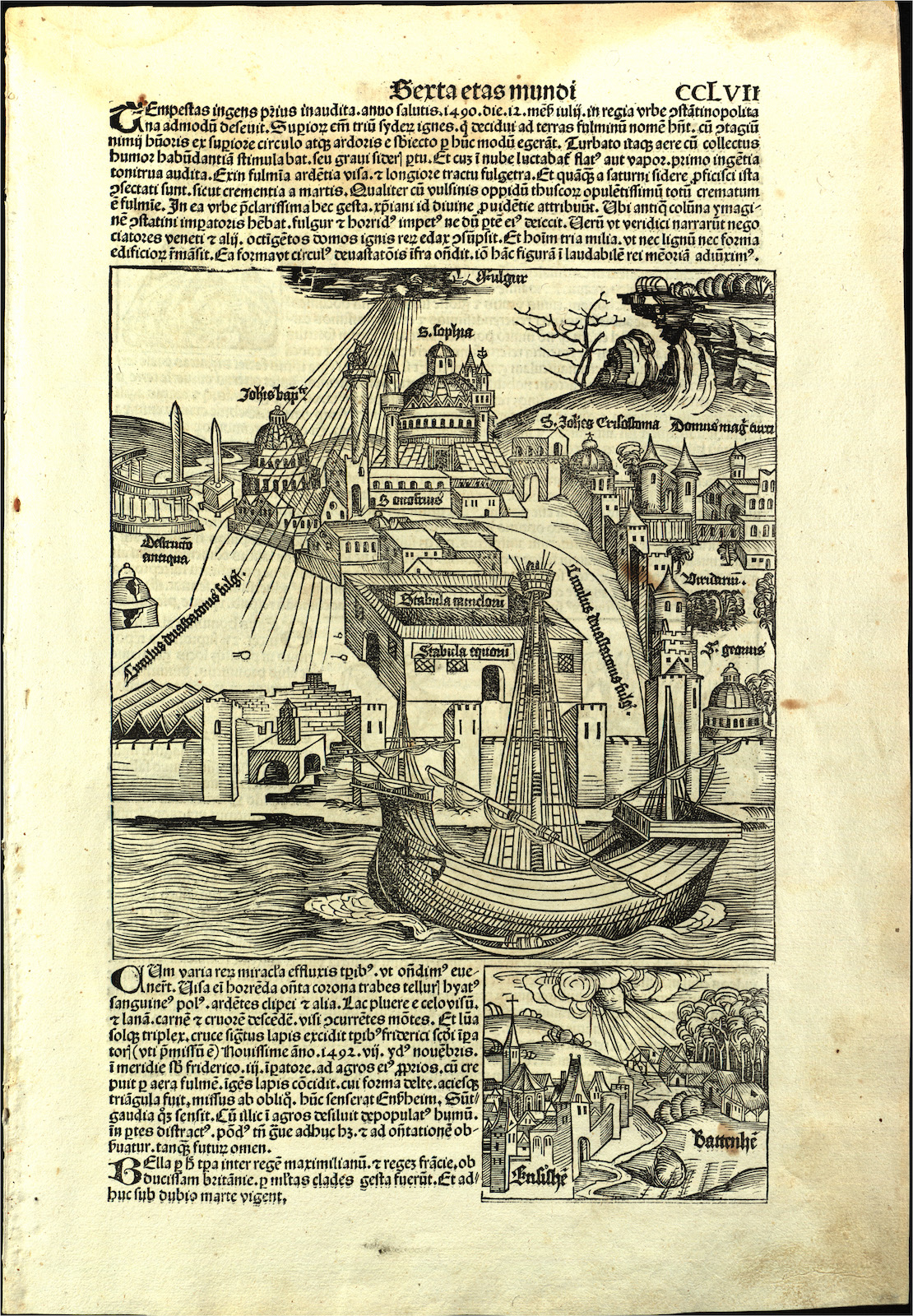
Recto: "Great Storm"
Verso: Election of Pope Alexander VI; Story of Eleazar
Language: Latin
Portland State University Library Special Collections
Gift of Dr. Joe H. Rosenthal to the Harold Schnitzer Family Program in Judaic Studies.
Wyatt Lewis, Medieval Portland Capstone Student, Spring 2022
Folio CCLVII
Folio CCLVII recto illustrates and describes what is referred to as a "great storm" that occurred in Constantinople on the 12th of July, 1490, exactly 3 years before the first publication of the Nuremberg Chronicle. Aside from the few negligible stains that exist on the page, the page is in surprisingly good condition for an artifact of its age. All words and illustrations are clear and legible, as no stains are significant enough to obscure any of the contents of the page. The page has no color, and while may hold some artistic value, it is likely primarily intended to accurately illustrate the storm that took place.
The storm itself, according to the page, had a death toll of approximately 3,000 people and resulted in the burning of eight hundred homes.[1] Such a recent mass death event would certainly be worthy of note to include in the Nuremberg Chronicle, especially considering the assumed religious connotation that the storm itself had. The news of this storm would have certainly spread through traders that operated between “Konstantiniyye”, or “Istanbul” as it was popularly called, and the West. Before the Fall of Constantinople in 1453, Constantinople was considered one of the prominent Christian Capitals,[2] and was home to many Christian churches After Sultan Mehmed II conquered Constantinople for the Ottoman Empire, he spent the rest of his life transforming Constantinople into a predominantly Islamic cosmopolitan city that shared a mixed culture of “Perso-Islamic, Turco-Mongol, and Roman-Byzantine.”[3] This period was marked not only by general expansion, as Sultan Mehmed II was particularly inspired by Alexander the Great, but also by the demolishing of many churches that were replaced with Mosques. Beginning in 1459 when the city became the Capital of the Ottoman Empire. The most prominent of these churches was the Church of Holy Apostles which was replaced with the New Mosque. When the storm occurred in what was then being popularly referred to as Istanbul, the Christian population believed that it was divine punishment against the city, presumably for this decades-long shift that saw the destruction of churches and the establishment of the mosques that replaced them. Lightning struck the Column of Constantine during the storm, causing considerable damage to the prominent Christian monument and furthering this belief. According to a Russian traveler who had visited the city, the Column of Constantine was adorned with a cross and even contained 12 baskets of bread, representing Jesus’ 12 Apostles, as well as Noah’s ax, a Christian relic with biblical importance.[4] The column was one of the remaining monuments to Constantine and Christianity within the city, as many monuments commemorating Constantine were replaced with monuments to Sultan Mehmed II,[5] and was undoubtedly important to the Christian population that remained in the capital of the Ottoman Empire. Due to the Christian inclination of the Nuremberg Chronicle, a mass death event such as this, with the potential cause being the wrath of God, was certainly worthy of being included in the text.
Folio CCLVII verso contains two different passages, the first is a simple account of the election of Pope Alexander VI as well as his general competence as a member of the clergy. The page dedicates a large portion of its content to the journey of Pope Alexander VI, previously known as Rodrigo Borgia, on his path to the papacy. It does this all while describing the many virtues he displayed in his many clerical positions. This passage does mention that Alexander VI’s uncle, who was Pope Calixtus III, was who appointed him to his early positions within the clergy and was overall influential in Alexander VI’s success. This passage in the chronicle gives three reasons why praise should be given to Alexander VI, the first being that he is from Spain which produces “men who have always ranked highest and have been the most renowned in physical qualifications, in ingenuity, and in all virtues.”[6] The second reason is that he comes from Valencia, which, according to the chronicle, is the greatest of the Spanish cities. The third reason that is given is that he comes from a prominent family, like his uncle Calixtus III who was previously Pope. While this passage makes up for the majority of this page, the second passage holds much more concerning content.
The second passage coincides with the illustration of the people in the pit of fire details the story of Eleazar, a Jewish man who was living within the principality of dukes Balthasar and Mangen. On the 22nd of October, 1492, Eleazar obtained the “most Holy Sacrament of the Body of Christ,” and he, along with his relatives, stabbed the sacrament, and after doing so, the white linen cloth “bled” until it had become “discolored.”[7] This “miracle” reportedly frightened Eleazar and his relatives, and when they attempted to return this sacrament they were arrested and burned, as retribution for treating the Holy Sacrament in such a way. While the imagery and description of the detainment and burning of Jewish people in Germany draw obvious parallels to the Holocaust and Nazi Germany, this practice has its roots far before in medieval Germany, most notably the mass detainments and burning of nearly entire Jewish populations during the Black Death.[8] During the Black Death, the Jewish populations of many cities were blamed for the plague as people believed that the Jewish people had been poisoning the wells and streams.[9] This led to what is known as Black Death Pogroms, which were mass burnings of a city’s Jewish population.[10] These burnings were for retribution that the dominant population believed the Jewish people were owed, which all too closely parallels the account that is given of Eleazar. While the black death occurred from 1346 to 1352,[11] and the events of the story take place in 1492,[12] these black death pogroms were being celebrated in the cities that had them, such as Dusseldorf, which held a yearly festival commemorating the mass murder of their Jewish population until the year 1968.[13] The Chronicle page itself confirms the continued use of pogroms or other associated group burnings that were used to enact perceived retribution against Jewish peoples.
Notes
[1] “Nuremberg Chronicle: Folio CCLVII Recto,” Morse Library. n.d.
[2] Sabanci University, “From Byzantion to Istanbul” 2010.
[3] Sabanci University, “From Byzantion to Istanbul” 2010.
[4] Majesta, George P. “Russian Travelers to Constantinople in the Fourteenth and Fifteenth Centuries” 1984. 34, 144.
[5] Sabanci University, “From Byzantion to Istanbul” 2010.
[6] Morse Library, “Folio CCLVII Verso” n.d.
[7] Morse Library, “Folio CCLVII Verso” n.d.
[8] Voigtländer, Nico, and Hans-Joachim Voth. “Persecution Perpetuated: The Medieval Origins of Anti-Semitic Violence in Nazi Germany.” 2012. 1340-1351
[9] Cohn, Samuel K. “The Black Death and the Burning of Jews.” 2007. 3-36.
[10] Voigtländer. “Persecution Perpetuated” 2012.
[11] Cohn “The Black Death and the Burning of Jews.” 2007.
[12] Morse Library, “Folio CCLVII Verso” n.d.
[13] Voigtländer. “Persecution Perpetuated” 2012.
Bibliography
Cohn, Samuel K. 2007. “The Black Death and the Burning of Jews.” Past & Present, no. 196: 3–36.
From Byzantion to Istanbul: 8000 years of a Capital. Istanbul: Sabanci University: Sakip Sabanci Museum, 2010. 262-277
Majesta, George P. 1984. Russian Travelers to Constantinople in the Fourteenth and Fifteenth Centuries. Washington D.C.: Dumbarton Oaks. 34, 144.
Morse Library, Beloit College. “Nuremberg Chronicle: Folio CCLVII Recto”.
https://digicoll.library.wisc.edu/cgi/t/text/text-idx?c=nur;cc=nur;view=text;idno=nur.001.0004;rgn=div2;node=nur.001.0004%3A8.337
Morse Library, Beloit College. “Nuremberg Chronicle: Folio CCLVII Verso”.
https://digicoll.library.wisc.edu/cgi/t/text/text-idx?c=nur;cc=nur;view=text;idno=nur.001.0004;rgn=div2;node=nur.001.0004%3A8.338
Voigtländer, Nico, and Hans-Joachim Voth. 2012. “Persecution Perpetuated: The Medieval Origins of Anti-Semitic Violence in Nazi Germany.” The Quarterly Journal of Economics 127 (3): 1339–92. https://doi.org/10.1093/qje/qjs019